October 10, 2010 (28th Sunday in Ordinary Time)
1. For many of us, there was a childhood ritual that occurred the day after Christmas or after your birthday when you were kids. Your mom marched you to the dining room table, sat you down, and made you write thank you notes. You had to say thanks, to discuss more or less how much you liked the lumpy sweater or the toy you received from Grandma. You had to describe how you would use it, and how much it meant to you. In my family, and maybe in yours, though, the content of the thank you note did not matter quite so much as the basic existence of said note. You could be ecstatic with gratitude in your heart, but if you didn’t write a note, and actually say “thank you,” that was a BIG problem.
2. In today’s gospel reading, we get to see what it was like for Jesus to do something for someone else and not get the equivalent of a thank you note. As in much of Luke, Jesus is on the road from his home in Galilee toward Jerusalem. On this road, in a border region between Jewish Palestine and Samaria, Jesus comes across a small leper colony. In the ancient world, communicable skin diseases were a terrible scourge, and people who had these diseases were forced to live in quarantine away from healthy people. And the quarantine was especially serious for Jewish lepers since the Jewish law exacted strict standards of physical and ritual purity. Even if a leper recovered from his illness, he could not re-enter Jewish society without first checking with a priest and getting his stamp of approval. So these lepers were doubly excluded from life: from day to day interaction with healthy people and any interaction with the ritual life of their religion. By this time in Jesus’ ministry, it was well known throughout the region that he was a miracle worker—he had healed hundreds if not thousands of sick people, and even these quarantined lepers knew that he was probably their only chance to be cured. So, when he comes within earshot, they call out for his mercy.
So, being Jesus, Jesus cures them. He sends them to be checked out by religious authorities in the temple, and as they turn to go, they discover that they are all better. And you know how it ends. Only one comes back to say thank you. To accentuate how unique, how special, it is that this one is giving thanks, Luke tells that of the ten lepers, only the Samaritan, the foreigner, came back.
3. We don’t often think of how Jesus felt. We are more likely to think of him as all-powerful, or as a perfect example, or as a teacher, or as a character in an ancient story. But he was a person. He had feelings. He could be happy, he could be sorrowful. And I have no doubt that he could have his feeling hurt. It had to sting that he had healed ten and only one said thank you. Now, it was not necessary for the other nine to say thanks—it wasn’t like Jesus took their healing away from them because of their lack of good grace. But you know and I know that it is nice to hear “thank you.”
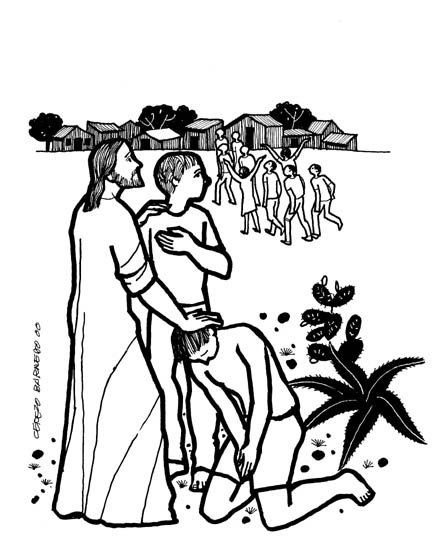
4. It takes a while to learn to express gratitude. I’m sure this is why our mothers made us sit down and write thank you notes. We are so oriented to receive and to take that it is all too easy to forgo gratitude altogether. We can be a lot like the nine lepers. They’re not all bad. They had faith in Jesus and his power and his mercy. And they were good at following directions. When Jesus tells them to go to the temple and show themselves, they get right to it. But Jesus is not their drill sergeant. When he says “frog,” he doesn’t expect people to jump. The great preacher Barbara Brown Taylor puts it this way: “I know how to be obedient but I do not know how to be in love.” Oh yeah. To be grateful is to acknowledge a relationship. It is to acknowledge the tie between you and God, or you and someone else.
Author David Steindl-Rast suggests that when we say thank you to God, we are implicitly saying that we are close to God. He writes, “One who says, ‘Thank you’ to another really says, ‘We belong together.’” In this sense, expressing gratitude is one way of expressing love.
5. Of course, the first step in being thankful is to notice the blessings you have received. Presbyterian minister Lynne Baab says, “It is truly amazing how many blessings we can notice if we take the time to pay attention. It changes our heart over time if we try to notice all the ways God is already working, rather than focusing on the ways we want God to act.” If we spend all our prayer time asking God to do more we can forget to spend time thanking God for what God has already done.
6. Perhaps this is why our own worship is based so much on giving thanks. When we come together to pray, we like to celebrate what God has done and is doing. Sure, we also try to be obedient to God and God’s desires for our lives. And we also ask God to intercede on our behalf. But when we come to worship, we come with thanksgiving and praise on our lips. We praise God for being who God is, and we thank God for doing the things God does.
One of the central features of our worship is the sacrament of communion, also known as the Lord’s Supper or the “Eucharist.” The word “eucharist” means “thanksgiving” in Greek. And the Great Prayer of Thanksgiving is what we call the prayer that ties the Lord’s Supper together. In one way, it is a prayer of gratitude before a meal.
It begins this way:
The Lord be with you. And also with you.
Lift up your hearts. We lift them to the Lord.
Let us give thanks and praise. It is truly right and our greatest joy to give our thanks and praise.
Now, I bet a lot of things give you joy in this world. The sunshine, the blue sky, spending time with loved ones, meaningful work, etc. But in this prayer, we say together that OUR GREATEST JOY is to give thanks and praise to God. It is our greatest joy because in so doing, we recognize and remember that we love God and God loves us. We remember all the great and merciful acts that God has done for us in history, culminating in the gift of Jesus Christ. And we are grateful. We are grateful not because we are such great people with such exquisite manners. We are grateful because of who God is. Because God is who God is, it is truly right and our greatest joy to give God our thanks and praise.
7. We all need to remember this sacrament, this Great Thanksgiving, and build up personal and community habits of gratitude. Our Wednesday morning study group recently spent some time considering gratitude as a spiritual discipline. We discussed what a good idea it would be in our prayer lives to spend more intentional time counting our blessings and saying thanks to God. There are so many motives for gratitude: in the creation, in our families, among our friends, in our work—you name it, there are lots of ways God is caring for us and building us up. Like the Samaritan leper, we ought to turn around and say thanks. And saying thanks, building up those habits of gratitude, will lead to an even better appreciation of God’s never-ending love. Theologian Dietrich Bonhoeffer wrote: “Only they who give thanks for little things receive the big things. We prevent God from giving us the great spiritual gifts he has in store for us because we do not give thanks for daily gifts.”
So, we thank you God for the little things you do for us. We thank you for this church. We thank you for our homes. We thank you for our friends. We thank you for being with us. We thank you for Jesus and his love for us. We thank you and we acknowledge that we depend on you for everything, big and small.
I would like to close with a prayer that was written by Rev. John Thomas, the president and general minister of the United Church of Christ denomination.
“Let us pray: Teach us to practice gratitude in our lives that we may honor the graciousness at the center of your creation. Forgive every form of self-centeredness that assumes we are entitled to what we have and make us mindful of every good gift and of every good gift-giver. Thus, may we return again and again to you as those redeemed and renewed by your love rather than our deserving and so experience the joy of your presence that makes us well. Amen.”

No comments:
Post a Comment