Tuesday, October 26, 2010

It's a Trap!

Luke 18:9-14
October 24, 2010 (30th Sunday in Ordinary Time)


1.  In 1980, singer Mac Davis came out with a hit song.  Here’s the chorus from that song:
Oh Lord it's hard to be humble when you're perfect in every way
I can't wait to look in the mirror 'cause I get better lookin' each day
To know me is to love me, I must be a h(eck) of a man
Oh Lord it's hard to be humble, but I'm doin' the best that I can
One of the reasons I like this song is because I know there are a lot of humble people in church!  Let’s have a show of hands here.  Who out there is humble?  Ok.  Well, who out there is the most humble?  Raise your hand!  Don’t be shy! 

Of course, there’s the rub.  We knew we were in trouble when the gospel reading starts with the clear statement that the following parable is for people “who trusted in themselves that they were righteous and regarded others with contempt.”  The last time I checked, most of us think our opinions and beliefs are right, if not righteous.  And people who don’t see things our way, if not contemptible, are at least sadly mistaken. 
It’s an especially tricky problem for those of you who may have enjoyed some power or authority in your life.  A good one that Susie Delano shared with me this week comes from the inimitable Mohammed Ali:  Prior to take-off on a plane, Mohammed Ali, was told to fasten his seat belt. He boastfully replied, "Superman don't need no seatbelt,"  to which the flight attendant responded, "Superman don't need no airplane either."
Oh Lord, it’s hard to be humble!

2.  The parable from Luke seems simple.  Two men go up to pray in the temple.  The Pharisee gets up in a good public place and crows on and on about how great he is.  He is religiously perfect—fasting and tithing on a regular basis.  He thanks God for his ability to be faithful like this, and he is especially thankful that he is not some villainous piece of garbage like the traitorous and thieving tax collector he sees across the way.  The trouble with the Pharisee, unfortunately, is that biblical scholars tell us that Pharisees were hardly the self-righteous blowhards we often imagine them to have been.  The Pharisees were a movement in Judaism to make the keeping of the law more of a daily practice accessible to all the Jewish people rather than just to the priests in the temple.  They believed that Jews would be better off in religious terms if all would keep God’s law more carefully and in everyday ways.  Most scholars admit that Jesus himself shared many of these Pharisaical tendencies.  And, except for the part where this Pharisee specifically thanks God for not being some lesser person, it’s not that terrible of thing to thank God for helping you be good! 
What about the tax collector?  It’s not easy to imagine a modern-day equivalent to the tax collector—he was not much like an IRS agent.  Tax collectors were entrepreneurs who collected taxes for the Roman Empire—as such they were considered traitors, and it was common knowledge that they used extortion, graft, and all kinds of thievery to shake down the populace.  Any money they collected above what was owed to the Romans went right in their pockets.  The closest analogue in our society might be a loan shark or a Mafioso who also oozed the opposite of patriotism.  This particular tax collector, the one in the parable, has apparently come to some sort of crisis point in his life.  From the description given, he seems to be honestly convicted of his sinfulness as he prays, “God, be merciful on me, a sinner!”
It’s easy, even given what I’ve told you about how the Pharisees weren’t all that bad and how the tax collectors were that bad and worse, to be attracted to the humble and contrite tax collector and be repulsed by the bragging and pious Pharisee.  Even Jesus seems to point us this way, saying that the tax collector went home justified, meaning that he went home set right by God.  Obviously, our sympathies should go with the tax collector even as our condemnation should be against the proud Pharisee.

3.  But watch out!  This parable is a trap!  You see, as soon as we feel superior to the Pharisee, we become the Pharisee.  Preaching professor David Lose says, “For as soon as we fall prey to the temptation to divide humanity into any kind of groups, we have aligned ourselves squarely with the Pharisee. Whether our division is between righteous and sinners, as with the Pharisee, or even between the self-righteous and the humble, as with Luke, we are doomed. Anytime you draw a line between who's "in" and who's "out," this parable asserts, you will find God on the other side.”  Lutheran pastor John Petty agrees.  He writes, “The twist is that even when we're at our best, such as the pharisee, we're actually worse off than we were before we shaped up.  Now, we're under the illusion that we're "special" and "better."  [This is a special kind of irony.]  It means that even when we think we're close to God--especially then--our self-righteousness in thinking so means we're actually farther from God than we were to begin with.”
This is why trying to be humble is a losing proposition.  In fact, it might not even be possible to try to be holy!  When we try, we inevitably fail, or we succeed, but in succeeding, we alienate others with our pride at managing to be so holy.  No wonder so many people outside of the church (and even inside it) think that we Christians are hypocrites.  If you’re like me, you have at least one family member and probably several friends who are to willing to tell you that they don’t go to church because it’s full of a bunch of over-pious hypocrites.  They don’t want to be part of that!

4.  As much as we would like for these people to come to church and see that church is so much more than their negative perceptions, we have to admit that Pharisees and good church people can be hard to take.
Regarding this passage, theologian Albert Nolan has said that, “One of the basic causes of oppression, discrimination and suffering in that society was its religion….And nothing is more impervious to change than religious zeal.  The piety and good works of the dutiful religious man made him feel that God was on his side.  He did not need God’s mercy and forgiveness; that was what others needed.  The sinner, on the other hand, was well aware of his desperate need for mercy and forgiveness and of his need to change his life….Jesus soon discovered that it was the dutiful religious man, rather than the sinner or pagan Roman, who was an obstacle to the coming of the kingdom of total liberation.” 
The same goes for us in these days.  How many times have you seen a poor person on the side of the road or some other suffering person in this world and uttered something to yourself like, “There but for the grace of God go I.”  Or, when you are totally honest with yourself, how many times have you thought, “I am so grateful that I’m not like someone else.”?  I’m not proud of it, but my parents taught me when I was young that it was better to be an American than to be anything else.  So, by being an American, am I better?  Am I luckier?  Am I more justified by God?  Please remember that the tax collector went home justified. 

5.  So what’s it going to take?  How can we reset this whole situation so that it is not a trap?  How can we live in such a way that we can live as God would have us live (like the Pharisee) and avoid the prideful comparisons (also like the Pharisee)?  How can we be justified, saved, redeemed, set right, and set free by God alone?
Well, it’s useless to try to be humble.  So why don’t we try to love like Jesus?  Why don’t we try to love the sin-soaked tax collector amongst us?  Why don’t we love the criminals, the sex offenders, the terrorists, the illegals, the repulsive?  And while we’re at, why don’t we love the Pharisee, the boor, the braggart, the self-righteous, the overly confident?  Author Jayne Hoose points out that, “To act towards others out of love often requires us to look beyond the obvious.  What is it that compels the Pharisee to compare himself favorably to the tax collector before God?  [Why did he need to do that?] A more loving response to this parable might be to try to understand the underlying needs and hurt of both the Pharisee and the tax collector.  It is only when we regard others out of love that true humility follows.  Love and humility are essential partners.” 

6.  Jesus has a way of doing this to us.  He tells a story that seems obvious:  the Pharisee is a schmuck and the tax collector is justified.  But as the story pulls us in, and we go farther and farther into it, we end up where we so often end up:  standing with all the rest in need of love.  We need to be loved and we need to give love.  Love your neighbor as yourself, even if he is a Pharisee, even if she is a tax collector.  And, neighbor, we will love you. 
Let us pray:
Holy God, our righteous judge, daily your mercy surprises us with everlasting forgiveness.  Strengthen our hope in you, and grant that all peoples of the earth may find their glory in you, through Jesus Christ our Savior and Lord.  Amen. 

RELATED VIDEO:

Monday, October 11, 2010

Our Greatest Joy

Luke 17:11-19
October 10, 2010 (28th Sunday in Ordinary Time)


1.  For many of us, there was a childhood ritual that occurred the day after Christmas or after your birthday when you were kids.  Your mom marched you to the dining room table, sat you down, and made you write thank you notes.  You had to say thanks, to discuss more or less how much you liked the lumpy sweater or the toy you received from Grandma.  You had to describe how you would use it, and how much it meant to you.  In my family, and maybe in yours, though, the content of the thank you note did not matter quite so much as the basic existence of said note.  You could be ecstatic with gratitude in your heart, but if you didn’t write a note, and actually say “thank you,” that was a BIG problem. 

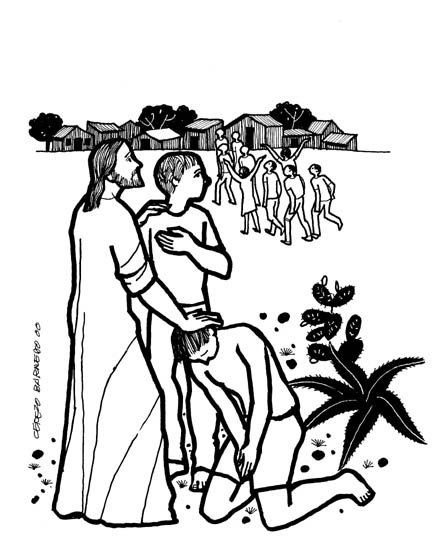
2.  In today’s gospel reading, we get to see what it was like for Jesus to do something for someone else and not get the equivalent of a thank you note.  As in much of Luke, Jesus is on the road from his home in Galilee toward Jerusalem.  On this road, in a border region between Jewish Palestine and Samaria, Jesus comes across a small leper colony.  In the ancient world, communicable skin diseases were a terrible scourge, and people who had these diseases were forced to live in quarantine away from healthy people.  And the quarantine was especially serious for Jewish lepers since the Jewish law exacted strict standards of physical and ritual purity.  Even if a leper recovered from his illness, he could not re-enter Jewish society without first checking with a priest and getting his stamp of approval.  So these lepers were doubly excluded from life:  from day to day interaction with healthy people and any interaction with the ritual life of their religion.  By this time in Jesus’ ministry, it was well known throughout the region that he was a miracle worker—he had healed hundreds if not thousands of sick people, and even these quarantined lepers knew that he was probably their only chance to be cured.  So, when he comes within earshot, they call out for his mercy. 
So, being Jesus, Jesus cures them.  He sends them to be checked out by religious authorities in the temple, and as they turn to go, they discover that they are all better.  And you know how it ends.  Only one comes back to say thank you.  To accentuate how unique, how special, it is that this one is giving thanks, Luke tells that of the ten lepers, only the Samaritan, the foreigner, came back. 

3.  We don’t often think of how Jesus felt.  We are more likely to think of him as all-powerful, or as a perfect example, or as a teacher, or as a character in an ancient story.  But he was a person.  He had feelings.  He could be happy, he could be sorrowful.  And I have no doubt that he could have his feeling hurt.  It had to sting that he had healed ten and only one said thank you.  Now, it was not necessary for the other nine to say thanks—it wasn’t like Jesus took their healing away from them because of their lack of good grace.  But you know and I know that it is nice to hear “thank you.” 
 
4.  It takes a while to learn to express gratitude.  I’m sure this is why our mothers made us sit down and write thank you notes.  We are so oriented to receive and to take that it is all too easy to forgo gratitude altogether.  We can be a lot like the nine lepers.  They’re not all bad.  They had faith in Jesus and his power and his mercy.  And they were good at following directions.  When Jesus tells them to go to the temple and show themselves, they get right to it.  But Jesus is not their drill sergeant.  When he says “frog,” he doesn’t expect people to jump.  The great preacher Barbara Brown Taylor puts it this way: “I know how to be obedient but I do not know how to be in love.”  Oh yeah.  To be grateful is to acknowledge a relationship.  It is to acknowledge the tie between you and God, or you and someone else. 
Author David Steindl-Rast suggests that when we say thank you to God, we are implicitly saying that we are close to God.  He writes, “One who says, ‘Thank you’ to another really says, ‘We belong together.’”  In this sense, expressing gratitude is one way of expressing love. 

5.  Of course, the first step in being thankful is to notice the blessings you have received.  Presbyterian minister Lynne Baab says, “It is truly amazing how many blessings we can notice if we take the time to pay attention.  It changes our heart over time if we try to notice all the ways God is already working, rather than focusing on the ways we want God to act.”  If we spend all our prayer time asking God to do more we can forget to spend time thanking God for what God has already done. 

6.  Perhaps this is why our own worship is based so much on giving thanks.  When we come together to pray, we like to celebrate what God has done and is doing.  Sure, we also try to be obedient to God and God’s desires for our lives.  And we also ask God to intercede on our behalf.  But when we come to worship, we come with thanksgiving and praise on our lips.  We praise God for being who God is, and we thank God for doing the things God does. 
One of the central features of our worship is the sacrament of communion, also known as the Lord’s Supper or the “Eucharist.”  The word “eucharist” means “thanksgiving” in Greek.  And the Great Prayer of Thanksgiving is what we call the prayer that ties the Lord’s Supper together.  In one way, it is a prayer of gratitude before a meal. 
It begins this way:
The Lord be with you.  And also with you.
Lift up your hearts.  We lift them to the Lord.
Let us give thanks and praise.  It is truly right and our greatest joy to give our thanks and praise.
Now, I bet a lot of things give you joy in this world.  The sunshine, the blue sky, spending time with loved ones, meaningful work, etc.  But in this prayer, we say together that OUR GREATEST JOY is to give thanks and praise to God.  It is our greatest joy because in so doing, we recognize and remember that we love God and God loves us.  We remember all the great and merciful acts that God has done for us in history, culminating in the gift of Jesus Christ.  And we are grateful.  We are grateful not because we are such great people with such exquisite manners.  We are grateful because of who God is.  Because God is who God is, it is truly right and our greatest joy to give God our thanks and praise. 

7.  We all need to remember this sacrament, this Great Thanksgiving, and build up personal and community habits of gratitude.  Our Wednesday morning study group recently spent some time considering gratitude as a spiritual discipline.  We discussed what a good idea it would be in our prayer lives to spend more intentional time counting our blessings and saying thanks to God.  There are so many motives for gratitude:  in the creation, in our families, among our friends, in our work—you name it, there are lots of ways God is caring for us and building us up.  Like the Samaritan leper, we ought to turn around and say thanks.  And saying thanks, building up those habits of gratitude, will lead to an even better appreciation of God’s never-ending love.  Theologian Dietrich Bonhoeffer wrote: “Only they who give thanks for little things receive the big things. We prevent God from giving us the great spiritual gifts he has in store for us because we do not give thanks for daily gifts.” 
So, we thank you God for the little things you do for us.  We thank you for this church.  We thank you for our homes.  We thank you for our friends.  We thank you for being with us.  We thank you for Jesus and his love for us.  We thank you and we acknowledge that we depend on you for everything, big and small. 
I would like to close with a prayer that was written by Rev. John Thomas, the president and general minister of the United Church of Christ denomination. 
“Let us pray: Teach us to practice gratitude in our lives that we may honor the graciousness at the center of your creation. Forgive every form of self-centeredness that assumes we are entitled to what we have and make us mindful of every good gift and of every good gift-giver. Thus, may we return again and again to you as those redeemed and renewed by your love rather than our deserving and so experience the joy of your presence that makes us well. Amen.”

Monday, October 4, 2010

Faith to Move

Luke 17:5-10
October 3, 2010 (27th Sunday in Ordinary Time)


1.  Do you remember the story from the book of Exodus about the Israelites wandering around in the desert for 40 years?  It was tough going through those forty years, just one of the many tough times they went through.  If you’ve been listening closely to our Old Testament readings for the last few weeks, you’ve been hearing the sad stories of exile and punishment from the biblical prophets.  Well, anyway, getting back to the Exodus—do you remember that the Israelites were hungry out in the middle of nowhere?  God hears their complaints and gives them manna, which is this sort of flaky sweetbread that settled with the morning dew.  God commanded that each family gather only as much manna as they would need for one day, anything extra would go bad.  And, in fact, those greedy families who hoarded the manna would find that it would not last more than one day—the leftovers would quickly fill with worms and become inedible. 
Naturally, this whole experience with manna has become a powerful metaphor for both Jews and Christians who are trying to remember that God will meet our daily needs.  In the wilderness, the Israelites didn’t need barrels full of manna; they just needed enough to sustain them each day.

2.  The disciples in this morning’s gospel reading want more than what is sufficient for one day.  They say to Jesus, “Increase our faith!”  Wouldn’t that be great?  Wouldn’t it be wonderful if you had so much faith you could store it away for those times in your life when you know you could use an extra boost?  It’s not completely possible to be sure about the tone of Jesus’ response, but I like to think that he laughs at the disciples a little.  He seems to say, “You need more faith like the ancient Israelites needed more manna!  What are you going to do with all this surplus faith?  Do you honestly have a need to plant mulberry trees in the ocean?  Do you honestly have a need to move mountains with the power of your faith?  The last time I checked, the faith that you have was getting you through the day!” 

3.  Like manna, it seems you can’t store up faith.  In fact, the gospel passage seems to suggest that the question is not “How much faith can I have?” but rather is “What is my faith for?”  Professor Kim Long writes, “In this economy, faith is not stockpiled in a storehouse for the working of spiritual wonders, but is lived out as obedience to a just and loving God….[F]aith cannot be measured, only enacted.” 

4.  Back in the late 1800s, there was a famous Methodist revival preacher named Samuel P. Jones.  He did a lot of preaching in Ryman Auditorium, which nowadays is the home of the Grand Ole Opry.  I want to share with you a piece of one of Rev. Jones’s sermons.
[An old church member] says, “I am waiting for faith.”  Yes, you have been waiting forty years for faith.  How much have you saved up?  Like the fellow who had ten bushels of wheat, and was waiting till more grew before  he could sow what he had.  Sow it, and you will have a hundredfold.  By keeping it, you will not get any more, but the rats will eat up what you have.
… “I want to be a blacksmith as soon as I get muscle.”  Why don’t you go at it?  There he stands until at last he has got muscle enough to lift the hammer.  He is “getting it” with a vengeance.  How did you get faith?  By using what you had.  I tell you what tickles me—to hear fellows down praying for faith.  “Lord, give me faith.”  The next time you get any in that way, bring it over and let me see it.  That ain’t scriptural, that talk you are doing now.  Christ rebuked those who prayed for faith.  The trouble with you is not that you need more faith.  You use the faith you have, and then you will get more.  I would as soon pray for sweet potatoes as faith.”
I love that last line!  “I would as soon pray for sweet potatoes as faith”!

5.  Rev. Jones is surely right.  Use your faith if you want more of it.  This is the gist of the story Jesus tells the disciples when he asks if the master should invite the slaves in for dinner after a hard day’s work.  The answer, at least in Jesus’ day and age, was “no, I would have them continue serving me since they are meant to serve.”  Jesus concludes, “So you also, when you have done all you were ordered to do, say… ‘we have done only what we have ought to have done.’”  In other words, we must not forget that God is our God, and we are here to serve.  We don’t need more faith, or an increase, because we have what we need from God to serve right now.  Faith, if we can talk about it increasing at all, increases in service.

6.  And how do we know this?  German theologian Margit Ernst-Habib  says that we need to “understand the faith talked about [in this passage] as Christian, not in the sense of the faith of the Christians, but in the sense of the faith in Christ that mirrors the faith of Christ.”  You see, when Jesus tells us we need to serve if we want to have faith, he is not just telling us what to do.  He himself models this.  Jesus Christ is the Lord who serves.  He serves the poor, he serves the sick, he serves the downcast, he serves the lonely, he serves the stranger, he serves you, and he serves me.  This is the faith to move.  Faith, in a very real sense, can hardly be thought of as a noun, but would better be considered a verb tied very closely to serving our God and neighbor. 

7.  There is a very famous line in a poem by Spanish poet Antonio Machado.  It is:  “Caminante, no hay camino; se hace camino al andar.” Or, “Traveler, there is no road... it's made by your own footsteps.”  So we move in faith. We reach out and serve.  We make the road ahead of us by walking and serving.  And that’s what actually constitutes our faith!  We can’t stockpile God’s gifts.  They are for sharing right now. 
On the night before his crucifixion, Jesus served the Last Supper to his disciples.  Because of that night, we continue to come together around this table to be with him and be strengthened by his own body and blood.  As part of that evening, Jesus stripped down to his undergarments, got down on his hands and knees, and like a slave washed the disciples’ feet.  If you want an increase in faith, this story is a great place to start.  We believe that the fullness of God was pleased to dwell in the man Jesus.  And this Jesus behaved as a slave to his followers.  And so, this meal, this bread and wine, remind us that we are to serve.  We are to reach out and care for others, to remember their dignity, and to remember that they, too, are beloved by God. 
So on this World Communion Sunday, we give thanks to God that our servant Lord taught us that faith is to give your life.  May we be strengthened at this table to move, to serve, and so to have faith.
Let us pray: 
By your will, O God,
we go out into the world
with the good news of your undying love,
and minister in the midst of human need
to show wonders of your grace.
We pray for men and women
who minister for you around the world.
May all Christians be strengthened by our mutual concern,
and supported by the sharing of our gifts.
Let us not be discouraged by doubts or other barriers
but make us brave and glad and hopeful in your word;
through Jesus Christ our Lord.  Amen.