Monday, December 6, 2010

Finding Jesus

Psalm 72:1-7, 18-19
December 5, 2010 (2nd Sunday of Advent)


1.  It’s only been two Sundays now since our celebration of Christ the King, but the image of kingdom, of a just and timeless reign of God’s love, is pretty much a constant in the scriptural witness.  We can’t just talk about kingship of Christ once a year and be done with it.  In fact, Advent continues to be a great time to discuss the promise of Christ’s eternal reign since in Advent we wait for Christ to come again and usher in the justice, peace, and love of his kingdom.  Of course, one of the other reasons we like to think about Christ as a leader—at any time of year—is because our own leaders, even the good ones, could really stand to improve drastically.  In this vein, Rev. Tod Mundo writes:
George Washington's likeness appears on our dollar bills and our quarters, and he is revered as the Father of Our Country. George Washington owned slaves. Andrew Jackson was one of the most popular presidents in U.S. history. Andrew Jackson promised the Choctaw and Cherokee peoples, "they shall possess [their land] as long as Grass grows or water runs"; when gold was discovered on their lands, his forgot his promises and drove them from their lands so that the white people could prosper. Theodore Roosevelt was a man with a reputation larger than life, and his face is carved on Mt. Rushmore. Theodore Roosevelt pushed the notorious Platt Amendment into the Cuban constitution, thereby stealing a measure of Cuba's sovereignty under the pretense of caring about the Cuban people. Great leaders sometimes have great faults. Poor leaders sometimes have even greater faults. Jim Hightower quips, "If God had meant for people to vote, he would have given us candidates."
The leaders in the Bible, with the one obvious exception of Jesus, are not too hot either.  King David is an adulterer and a murderer, his son Solomon has absolutely no self-control, the other kings of Israel and Judah mostly betray God and the religion of their ancestors.  In the New Testament, we have King Herod and Pontius Pilate not to mention all the other Roman authorities who keep Paul in and out of jail. 
Since the Bible, we Christians have long had a problematic relationship with our earthly leaders.  Worship professor Christian Scharen suggests that, “The worst moments in the long history of God’s people across history come to pass when leaders throw their lot in with the politically powerful.  Solomon and Herod are obvious examples, but so are church leaders in Germany during National Socialism or in Chile during the reign of Augusto Pinochet.  Year after year, people watch their rulers again succumb to corruption, greed, and power—some more, some less.”

2.  Psalm 72 must have been written by a poet that knew very well that earthly kings and leaders—and any collaboration between faithful people and those leaders—was usually marked by sinful missteps, faithlessness, and subjugation of the powerless.  The psalm, however, takes a hopeful approach:  instead of bemoaning how bad almost all kings have been, it focuses rather on a perfect future king who governs with justice for the poor and commitment to the well-being of all people.  The psalm itself is wonderfully positive about the king, and the son of the king.  Hearing this psalm with Christian ears, one immediately thinks of Jesus sitting on the throne of heaven.  In the words of the psalm, this king judges the “people with righteousness and the poor with justice.”  Under his rule, “the mountains yield prosperity for the people.”  It’s an amazing vision.  The king we await in these darkening days of December will finally be a good leader, the best leader.  One commentator on Psalm 72 wondered wistfully, What would it be like if all of our leaders today had to pass this acid test to be considered good leaders?  What if they had to bring justice to the poor and prosperity to the people?  It’s all too easy in today’s world to forget that we can and ought to expect more from those who aspire to serve us as leaders.  And continuing on a theme I started to discuss last week, wouldn’t it be amazing if we measured prosperity not in terms of gross accumulation of wealth but in terms of true and equitable well-being for all people?  Way back in 1968, Bobby Kennedy made this appeal.  He said:
Too much and too long, we seemed to have surrendered personal excellence and community values in the mere accumulation of material things.  Our Gross National Product…--if we should judge America by that--…counts air pollution and cigarette advertising, and ambulances to clear our highways of carnage.  It counts special locks for our doors and the jails for the people who break them.  It counts the destruction of the redwood and the loss of our natural wonder in chaotic sprawl….Yet the gross national product does not allow for the health of our children, the quality of their education or their play.  It does not include the beauty of our poetry or the strength of our marriages, the intelligence of our public debate or the integrity of our public officials.  It measures…everything in short, except that which makes life worthwhile.

3.  Psalm 72, as well as the other scripture readings we heard this morning from Isaiah and from Matthew’s gospel describe a future leader, a Christ, who will not measure prosperity or justice in the corrupt and limited terms of wealth and greed.  He will bring with him a peace and justice that far surpasses our meager expectations.  He will be like the “rain that falls on the mown grass, like showers that water the earth.  In his days…righteousness will flourish and peace [will] abound, until the moon is no more.”  The question of Advent is:  How do we wait?  How can we wait for Jesus to come and make the words of promise in Psalm 72 come true?  First, we look at the gospel of a Lord who has already come.  We pattern our lives after Jesus’ life and ministry while we wait, and we hope for a future where what God has started in Jesus comes  to a final and beautiful fullness.  Two great Methodist thinkers, Stanley Hauerwas and Will Willimon encourage us to do just this when they write, “The church is on the long haul, living in that difficult time between one advent and the next.  In such times, we are all the more dependent on a community that tells us we live between the times, that it is all too easy to lose sight of the way the world is, now that God has come.  Because we know something about the direction in which it is moving, we are encouraged by that picture and guided by the shape of its depiction of the way things are now that God has redeemed the world in Jesus.”
As John the Baptist teaches in our gospel reading from this morning, one greater than all of us is coming, one whose sandals we are not worthy to carry.  But in the meantime, as we await this wonderful incarnation of God, John reminds us that is our job in the here and now to “bear fruit worthy of repentance.”  In other words, while we place our ultimate hope in the coming Christ, in the interim we do his work.  We love as he loves, we ally ourselves with justice and mercy, we serve the needy, the oppressed and the poor, and we look to Jesus as our moral exemplar. 

4.  To do that, we need to go to where Christ is now.  Jesus, from his birth, lived with the poor, the sick, and those in need.  Psalm 72 asks that the king “defend the cause of the poor of the people, give deliverance to the needy, and crush the oppressor.”  We consider Jesus to be this king because he did and will do just that.  South African pastor Peter Storey was once addressing a group of well-off American church people.  He said something to them that I’m sure had to sting, but it is utterly true.  He said, “Those…churches struggling in places of poverty and injustice are fortunate—they are already where Jesus is.  Those who have become prosperous must find Him again.”  In our prosperity and comfort, our challenge this Advent is to go to where Jesus is, among the poor and the downtrodden.  What can you do in this season to find him?  How can you move yourself to a place where you can encounter the king of justice among the poor?  Can you give from your abundance to the needy?  Can you write letters to our leaders to encourage them to enact legislation that protects Jesus’ beloved?  Can you pray that the world will be transformed?  Can you pray that Jesus come and really want it, for your own sake and for the sake of all those on this earth who desperately need deliverance?  I’ve said it from this pulpit before but allow me to say it again:  God doesn’t help those who help themselves.  God helps those who can’t help themselves.  And you have been called to minister in Jesus’ name.  Find way to serve the poor, find a way to serve the lonely, find a way to share your prosperity, and you will find the king of peace.  You will find Jesus.  Amen. 

Thrones of Judgment

Psalm 122
November 28, 2010 (1st Sunday of Advent)


1.  It is my intention to focus our attention during this season of Advent on the Psalms that occur in the lectionary readings.  These ancient songs of temple, synagogue, and church—I hope—will provide us with just the right music for this time of expectation and preparation.  So, to get started, let me share with you a song that has become a favorite around our house, and, if I may modestly admit it, I wrote it myself.  I wrote the song as a response to my children’s frequent conviction that my decisions are not fair, or that their lives are too difficult, or that not all of their needs and wants are being met quickly enough.  The song goes like this:
There is no justice on this earth!
There is no justice, there is no justice,
There is no justice on this earth!
My kids don’t really care for this song, but I like it a lot.  For me, it revives ancient themes, ones that we often see in the Psalms themselves.  When the people of Israel look around at their position among the nations, they see that they are small to the point of insignificance, and all too often they are conquered and hauled off into exile.  Not surprisingly, perhaps, their songs lament the lack of justice on earth, but they also imagine a different world where there is justice.  A world where God is in charge in the holy city of Jerusalem, and things are the way they ought to be. 

2.  In Psalm 122, which we sang this morning, the psalmist finds joy in going to the house of the Lord because in that house, it is possible to imagine a world where God’s justice is the norm rather than the exception.  The words of the psalm asks us to pray for the peace and prosperity of Jerusalem. 
Of course, for the ancient Israelites as well as for many today, Jerusalem is the centerpiece of God’s creation.  It is the holy city where God is most pleased to dwell, the home of the ancient Hebrew temple, the home of Jesus passion and resurrection, and the home of the Dome of the Rock, one of the most revered places in Islam. 
And members of all three of these religions have longed after peace for Jerusalem even as all of them have also been guilty of bringing strife and warfare to this same city.  Jerusalem today is one of the most fraught places on the planet.  Everyone seems to want the city for themselves to the exclusion of others, and perhaps this is how they feel about our God as well.  We want God for ourselves in such a way that limits God’s potential affection for or relationship with other people. 
Jerusalem, in this way, becomes much more than one particular geographical city.  It rises to be the ideal place where all history comes together and God’s promises come true.  It is the place where people from all over the earth metaphorically pin their hopes and dreams, and it is for this reason that the psalmist’s appeal to us to go up and be happy worshiping God in Jerusalem is such a timeless hymn.  At the end of the seder meal at Passover, our Jewish brothers and sisters proclaim with hope:  “Next year in Jerusalem!”  Most have no sense that they will go to the earthly city called Jerusalem, the one that straddles the border between the modern political entities of Israel and West Bank.  They instead refer to the Jerusalem of promise, the holy city where God lives, the mount of Zion where ancient hungers are satisfied, where justice flows down like a stream, where swords are beaten into plowshares, and spears into pruning hooks, where we will learn war no more. 

3.  What marks our longing for this heavenly Jerusalem is our shared conviction that this will be a place that will feature both justice and peace.  We have a sense that justice and peace ought to be related somehow—after all, most of our towns have an elected position called “the justice of the peace” who is responsible for keeping order by settling disputes.  We know, instinctively maybe, that if we have justice, we will also have peace.  But there is plenty in our world to suggest the opposite.  Plenty of judgments are made everyday in our modern world that disturb the peace.  I refer to judgments which concentrate wealth in the hands of the few, judgments which choose knowingly to pollute the environment, judgments to make war instead of to seek peace, judgments that divide the powerful from the weak, the haves from the have-nots.  These kinds of so-called justice drive a wedge between people and make peace seem like a far-away fantasy.  But we know, as the psalmist knew, as the prophets knew, and as Jesus himself knew that true and godly justice will go hand in hand with peace.  For this reason, we can understand where the psalmist was coming from when he imagined a city where “thrones of judgment” were set up.  When the one doing the judging is the source of all creation and the author of justice, this is good news indeed.  This judge creates a city so just that no more harm is done, no more alienation occurs, no more oppression is possible.  In the purview of these thrones of justice, peace spreads.  No wonder the psalmist seems to equate the practice of justice with the act of making peace as well as with the liturgical praise of the people.  Justice-seeking equals peace-making equals praise-singing. 

4.  In front of these thrones of judgment, the sinful divisions we create unfairly between ourselves are done away with and we are all able to worship with freedom and human equality before our God.  In this act of justice, we find peace, but Psalm 122 also suggests that in this justice we will also find prosperity.  This prosperity is utterly unknown in our world, however.  Sure, there are plenty of people who are well-off today, but unlike earthly wealth, the prosperity in the psalm is not won at anyone else’s expense.  Biblical prosperity is not the accumulation of wealth in a system of scarcity.  It is rather the fair and equitable sharing of God’s gifts to us.  In this season of heightened consumerism and continuous demands that we buy more and spend more and live always at the edge if not beyond our means, it is instructive to remember that the prosperity and peace that are imagined in the Bible do not resign some people to poverty and dependence.  The peace of the house of God, where God’s justice reigns, is the kind of peace that restores the dignity of all people, that brings low the mighty and raises up the lowly; it is the dignity that comes unexpectedly both in a manger and in glory. 

5.  So, the psalmist says, “I was glad when they said to me, ‘Let us go to the house of the Lord!’
Our feet are standing within your gates, O Jerusalem.
Jerusalem—built as a city that is bound firmly together.”
When these words are intoned, who is it that belongs within Jerusalem’s gates?  Who is being invited to enter into this city of justice, where all is bound so firmly together?  Is it for us pious Christians gathered here this morning?  Is it for the holy?  Who can come into this city chosen by God?  In other words, who receives God’s promises?  To whom do they apply?  When Jesus says he came to seek out and restore the lost, to whom was he referring?  I suppose the thrones of judgment are for all people, ready or not.  For some, they will mean a reversal of fortune.  But for all people, the promise stands:  God’s justice will bring peace. 

6.  Well, you may be saying to yourself, “What does all this have to do with Jesus?  What does any of this have to do with Advent?”  Advent is a time when we affirm that the world can change.  Not by our own labors, but as the psalmist suggests, by the arrival of a just judge to sit on the thrones of judgment.  When Christ comes to reconcile the world for once and for all with God, the world will change.  The injustices, the grief, the inequality, will be set right.  Peace and true prosperity will reign.  We Christians must live off of this Advent hope.  It is like a song that has gotten stuck in our heads, and we can’t shake it.  We believe Christ can and will change the world. This is our story, this is our song.  Soon, little Avery Elizabeth will be baptized, and her own life will become part of this song of hope.  In her, as in all of us baptized, ancient promises are being answered.  As we await the coming of the Christ, let us see ourselves as we truly are.  Let us prepare ourselves for praise, for justice, and for peace-making.  I began with a cynical song about the lack of justice on this earth that I sing to my children.  Let us end with the hope that all of us—even our little children—will realize a new song of gladness, justice, and peace.  Amen.

Monday, November 29, 2010

King

Colossians 1:11-20 and Luke 23:33-43
November 21, 2010 (Christ the King)


1.  So did you hear the good news?  If you didn’t, you may be living under a rock!  Prince William is getting married to his long-time girlfriend, Kate Middleton!  Barring some unforeseen circumstance, William and his new wife will eventually ascend the throne of the United Kingdom.  William will be king, and his wife Kate will be Queen.  Our perennial interest in the British monarchy is fascinating—it would seem that our American democratic character cannot help but be intrigued with the romance and tradition of royalty.  We’ve all seen too many movies!  Biblical kings were more likely to be exploitative autocrats than ultra-suave, polo-playing dandies.  So what do we make of this strange Sunday at the end of the liturgical year?  What are we supposed to think about this idea that Christ is King?  Does he wear an ermine-lined cape and jeweled crown?  Does he live in a palace?  Does he rule with absolute authority, or does he leave most everything up to some celestial parliament?  And, perhaps the hardest question of all, can you accept/believe that you are subject to a monarch, no matter that it is Jesus?  Our scripture readings this morning can help us think some about what it means that Jesus Christ reigns as king.

2.  In the letter to the Colossians, our Savior Christ is described in terms of cosmic power.  The writer of this letter refers to Jesus as:
·         the image of the invisible God;
·         the firstborn of all creation;
·         head of the body, the church;
·         the beginning and the first born of the dead.
The passage declares that all things were created through Jesus Christ, meaning that you and I, the natural world around us, the air we breath, and the infinite expanse of the cosmos were all created in some mystical way through the person of Jesus.  Moreover, in this Jesus our King, the entire fullness of God has been pleased to dwell, and all of us can find reconciliation with God and with each other through him.
This vision of Christ is amazing, astounding, astonishing.  He is so far from the humble babe in the manger, far from the scruffy carpenter, far from the executed teacher and healer.  In my imagination, after reading this passage from Colossians, I imagine Jesus getting bigger and bigger until he fills my entire field of vision, until he fills the entire universe.  Even for a dyed-in-the-wool anti-authoritarian, it is not that difficult to feel like a subject of this larger-than-life Lord of Life.  It reminds me of another of my favorite New Testament passages: the hymn about Christ in the 2nd chapter of Philippians:
“Therefore God also highly exalted him and gave him the name that is above every name, so that at the name of Jesus every knee should bend, in heaven and on earth and under the earth, and every tongue should confess that Jesus Christ is the Lord”!

3.  But you may find yourself squirming with all this talk of an Almighty King.  Your relationship with Jesus isn’t like that maybe.  You don’t like the idea of bowing and scraping.  Jesus is your friend, your brother, your confidant.  Or, even if that’s not completely how you feel about him, he’s not some cosmic overlord!  If you feel this way, you are not alone.  Theologian Sallie McFague has been one of the  most trenchant critics of this way of thinking of Christ, or even God the Creator, as some Almighty Royal Figure.  She writes, “My criticism of [this monarchical model] focuses on its inability to serve as the imaginative framework for all of creation….
“The relationship of king to subject is necessarily a distant one: royalty is ‘untouchable.’  It is the distance, the difference, the otherness of God that is underscored in this imagery.  God as king in his kingdom—which is not of this earth—and we remain in another place, far from his dwelling.  In this picture God is wordless and the world is Godless: the world is empty of God’s presence, because it is too lowly to be the royal abode.”
Some of you have said something more or less like this to me, if not with McFague’s exact words.  You don’t like a king Jesus.  Thinking of Jesus as king makes him distant, out there, un-relatable. 
These criticisms suggest that Christ the King seems, at best, old-fashioned.  At worst, it takes away our own God-given human dignity and expects us to genuflect mindlessly as a way to keep us in our place.  As a lifelong Protestant, I remember how shocked I was the first time I saw news footage of the ordination service for a Catholic priest.  At one point in the service, he doesn’t merely kneel but rather complete prostrates himself face down on the floor before the altar at the front of the church.  I mean, in our churches, we don’t even have kneelers in the pews!  Our understanding of Christ simply does not call for this kind of self-abasement.  How can good democrats (lower-case “D”!) ever find any sort of comfort in a God who treats us like subjects of a king?

4.  The thing is, as our Gospel reading makes abundantly clear, Jesus is no ordinary king.  He is not far away and up above.  He is Jesus.  He died with criminals on the cross.  But even in his most agonizing moment, he was reaching out to them and inviting them into his kingdom, into his community.  This king is someone who, when confronted with earthly kings and powers, receives nothing but mocking.  They make fun of him!  “If you are the king of the Jews, then do something!  Save yourself!” 
When the author of the letter to the Colossians describes our Lord Christ as a Cosmic Lord, he must hold that vision of Jesus in tension with the King Jesus who rules from the throne of the cross with a crown of thorns.  We must also hold these two visions of king in tension.  One is the Lord to whom every knee must bow.  The other is the king who offers grace even to the criminal at the hour of his death.  If we bow to our King Jesus, we do so because he is with us and loves us.  He is not in some distant royal abode, but nor is he someone we can tuck away in our back pocket.  He is mighty, and he is kind.  He is merciful, and he is just.  All things were created through him, and he wants to know you personally.

5.  Perhaps the best wisdom I have heard concerning our celebration of Christ the King is from preaching professor David Lose.  Lose emphatically explains that when we make Christ our King, this is not just regime change.  We are not just replacing our worldly presidents and bosses and lords with Jesus.  Lose writes, “But the kingdom – or, maybe better, realm – of God that Jesus proclaims represents a whole new reality where nothing is the same – not our relationships or rules, not our view of self or others, not our priorities or principles – nothing. Everything we thought we knew about kings and kingdoms, in fact, gets turned right on its head.”  Lose continues, “If we believe that Christian faith isn't just allegiance to a different sovereign but rather is entrance into an entirely new realm, then who knows what God will expect from us. No longer can we keep our faith a private affair and ignore the need of our neighbor. No longer can we sing robust and rousing hymns about God's glory and majesty and ignore the plight of God's good earth. No longer can we pray that God's kingdom come and yet manage our wealth as if it actually belonged – rather than was entrusted – to us. And no longer can we relegate the realm of God to a comfortably distant – or for that matter frighteningly near – future. The realm and rule of God is all around us, beckoning us to live by its vision and values even now.”

6.  So, in this last week before we must absolutely get caught up in Advent and in Christmas, remember again that we exist in this church because Christ is our Head. He defines who we are and how we are to act. He welcomes us and sends us out.  He feeds us at this table, and calls us to feed others. 
I will conclude with words of praise from the book of Revelation:
Worthy is the Lamb who was slain,
to receive power and wealth
and wisdom and might
and honor and glory and blessing!  Amen.

Tuesday, November 16, 2010

Signs of the New Creation

Isaiah 65:17-25
November 14, 2005 (33rd Sunday in Ordinary Time)


1.  Hear again these words from the prophet Isaiah:  “For I am about to create new heavens and a new earth; the former things shall not be remembered or come to mind.”  Isaiah was writing to a people recently returned from their exile in Babylon.  Jerusalem was a shambles, families and farms and trades were all in disarray, and the world crowded all around as a constant threat.  The people needed to hear God’s promise again that a new creation is on its way.  Last week, we talked about heaven, and that’s part of this new creation.  But today we need to remember, like the ancient Israelites, that God is with us now.  God is creating something new and something better in our world in our lives right now.  We believe in a God who is doing a new thing, a God who puts a new heart within us, a God who rules over a place called the New Jerusalem.  We believe in a God who makes all things new. 

2.  One of the remarkable features of this passage from Isaiah is how specific are God’s promises concerning the new creation.  To be honest, it’s probably so specific because the prophet Isaiah was responding to specific injustices, real cases of public nastiness, particular instances of mean and sorry limitation.  In other words, the vision of the new in this passage points to some very concrete problems with the old.  And if you are a realist, what some might call a pessimist, you might not be too shy about pointing out that the old and awful world of the ancient Israelites that emerges from this passage is all too similar to our own world.  You might wonder: if God is bringing newness, if new creation is on its way, it seems to have been delayed.  Just like the experience of the Israelites, the world still crowds around us, our lives are all too often a total mess.
But don’t take my word for it.  There is proof that our world still cries out for something new. 
Isaiah promises that the new creation will not have infants who live but a few days.  While rates of infant mortality have decreased radically in the modern world, especially in developed nations, in the third world, infant mortality remains tragically high.  The CIA World Factbook puts infant mortality in the United States at the relatively low rate of 0.6%, but this still means that the U.S. is in 46th place in the world in terms of infant mortality.  Sadly, many nations in Africa still have infant mortality rates higher than 10%. 
Isaiah promises that all old people will live out a long life.  Again, in the industrialized world, this is basically true, with the exceptions we all can name resulting from accidents, murder, and disease.  But in other parts of the world, the average life expectancy is appallingly low, generally due to the AIDS epidemic.  Many countries in sub-Saharan Africa have a life expectancy hovering around 40 years. 
In the new creation in Isaiah, no one builds houses and then doesn’t live in them.  Nor does anyone plant crops and then not eat of them.  Of course, many today do not live in the houses they built.  National Geographic magazine says that in 2010 there are 35 million refugees in this world who have been forced from their homes by war and unrest.  Some agencies put that number much higher. 
And of course, in today’s global agricultural economy, few people eat the food that they plant in their fields.  Presbyterian mission co-worker Jed Koball explains that one of the key causes of hunger in the country of Peru today is the fact that many fields once used to provide food for the local population are now used to grow a cash crop, asparagus, for the North American market.  Examples like this one are unfortunately common. 
Finally, and perhaps most provocatively, in God’s new creation says Isaiah, no parents will “bear children for calamity.”  This is every parent’s most fervent hope for their children today, that they will never encounter calamity despite a world full of perils and traps.  Wouldn’t it be wonderful if none of our children ever experienced calamity? 
No wonder that Isaiah’s prophecy for an ancient people still sounds fresh and attractive to us today!  So many conditions of the old world still plague our contemporary time.  We still need a new creation.  We still need a new heaven and a new earth. 

3.  Noted Christian speaker and preacher Tony Campolo makes the bold claim that when Jesus came into the world, God’s promises came to pass.  Despite all that I’ve just said about the world still being in dire need of a new creation, Campolo argues that in Jesus, we have been given new life.  Jesus, in all the gospels, proclaims that, in him, the kingdom of God is coming near to us, and this is the beginning of the new creation.  Campolo writes, “[Jesus] wants to change this world into the kind of world that it ought to be. That’s why Jesus came, to create transformed people who in turn will live in a transformed world.”  This is why Jesus teaches his disciples—and us—to pray, “Our Father, who art in heaven, hallowed be thy name.  Thy kingdom come, thy will be done, on earth as it is in heaven.” 
In other words, Jesus among us is the turning point in history between the old world and the new, between the old life and the new life.  Ancient promises, like the one made in Isaiah to the Israelites, are answered in Jesus Christ.  And so now, even though the world can still feel awfully broken, it is on the mend.  Christ is with us, Emmanuel, in a whole new way, even in the trials and problems of modern life.
Campolo suggests that Hurricane Katrina was a good example of a new thing emerging even in the destruction of that storm.  Campolo writes, “When Katrina took place, [Jesus] was the first one who wept. He was the first one who cried. He was the one who was outraged because we didn’t build levees strong enough to hold back a hurricane force wind. He was the one who was outraged by the fact that there was so much poverty in New Orleans. To be Christian isn’t just to believe in Jesus, it’s to allow Jesus to invade you, to change your emotions, your feelings, your thinking.” 

4.  And when this transformation begins to take place, we start to be able to see signs of the new creation.  Life emerges where before there was none.  As Christians we need to remember that Jesus came to bring in the kingdom of God.  In him, the old world is being made new.  When you see new life emerge, you can be sure that is Christ at work.  When you see signs of the new creation, you are seeing the promises of God being fulfilled even now.  After the eruption of Mt. St. Helens in Washington in 1980, scientists and other observers were astonished by how quickly the landscape regenerated.  A 1987 article from Time magazine reported that, “What they observe is nothing less than a landscape being reborn. Nature is laboring mightily to transform the scoured flanks of the mountain, its debris- filled river systems and chemically polluted ponds and lakes into a facsimile of the sylvan setting that existed before the eruption. To the untutored eye, the evidence of devastation still seems overwhelming. Scientists, however, see a glass filling itself up slowly but surely. Says James MacMahon, head of the biology department at Utah State University: ‘It's not a forest yet, but the rate of progress is amazing.’”  Maybe all of us can think of areas in our own lives where we have been surprised by the rate of growth.  Where has Jesus been making new life in you?
And sometimes, this work of new life, this constant move toward wholeness, comes in even less expected and more sudden ways.  I recently heard a radio interview with musician Sxip Shirey.  Shirey grew up in rural Ohio on 54 acres of woods.  He loved it in the country.  But to make it as a musician, he realized it was going to be necessary to move to New York City, a place he initially detested.  It was ugly and crowded and unfriendly.  But then one night, he found himself on the roof of a friend’s 36-storey apartment building overlooking downtown Manhattan.  It was a deeply foggy night, and as he looked out, he saw the Twin Towers of the World Trade Center.  Their bases were covered in fog such that it looked like two enormous buildings floating in the clouds.  In the harbor, he could hear the foghorns of the boats, and to his right he could see the Brooklyn and Manhattan bridges lit and floating above the mist.  To his left, he could see the Statue of Liberty, and he at once felt connected to his Albanian grandmother who had emigrated through Ellis Island.  Then and there, Shirey discovered the life and the beauty of the city.  He said, “I felt connected on a spiritual level to the city for the first time.”  What was ugly was beautiful.  What had hurt and felt like a strange land had become home. 

5.  For us too, a new world is on its way.  Even when we feel alienated and when this world feels old indeed, our God is at work.  When we see the world through the redemptive lens of Christ, we note new life springing up.  When forgiveness is extended, when beauty shines forth, when relationships flourish, it is then that “the wolf and the lamb shall feed together, the lion shall eat straw like the ox.”  Open yourselves to Jesus and to what he is doing in you and in us to usher in a new creation.  Open yourselves to these promises and trust that our God is faithful.
Let us pray:  Almighty God, attune us to see your work in your world.  Open our hearts and minds to the many ways that you are bringing us new life.  May your kingdom so inspire us that we share your love and life with all.  In Jesus’ name, Amen.

Monday, November 8, 2010

Heaven

Luke 20:27-38
November 7, 2010 (32nd Sunday in Ordinary Time)

1. The genius American folk singer Woody Guthrie once wrote some extremely moving lyrics for a song called “Heaven.” Here are a few stanzas from that song:
It’s after my work tired and weary, I lay down to rest my eyes,
I see this world change in a whirlwind and heaven flies down from the skies;
I see rising up from the wreckage cities and mansions so bright
I see my friends’ eyes and their faces lit up with a bright shining light.
Every hand works in hand with the other and not for power nor greed;
Every hand works to its fullest ability and is paid in its deepest of need;
No cancer, no tuberculosis, no paralysis or asylums are here
No bowery nor skid row of homeless, no eye that is blinded by tears.
I know as you hear such a dream, friend, you will not pass it along;
I do not expect you to sing it as I do, nor to sing such a curious song;
I wrote down this song for my own self, and sing it now to my own soul.
But if you’ll sing songs of your dreamings, then you will reap treasures untold.
Guthrie captured a vision of heaven that was meaningful to him. It was a sort of workers’ paradise without disease or madness. But Guthrie realized that his vision may not be the best for everyone—his heaven may not be your heaven—but he encourages us all to reap the benefits of dreaming of a better future.
Is that what heaven is for us in the Christian Church? Is it just an imagined perfect place to comfort us through the misfortunes and sadness of this life? Is it somewhere that we actually go? Is it real? Do we fly around on angels’ wings strumming little harps?

2. These have been questions for Jews and Christians for thousands of years. Our gospel reading this morning shows Jesus in a tricky discussion with a group of economically powerful Jews known as the Sadducees. By Jesus’ day, most Jews believed in some sort of resurrection of the body and reunion with God in something like heaven after death, but the Sadducees stubbornly maintained a more ancient skepticism in Judaism about the reality of the resurrection. So they try to trip up Jesus, who had become famous for his preaching about the coming kingdom of God where all would be resurrected for eternal life. They try to trick him with a question about Jewish marriage customs in which a widow could marry her deceased husband’s brothers to try to conceive a child to carry on the deceased’s name. In the resurrection (that is to say, in heaven), to whom would the widow be married: the original husband or one of the later husbands? It’s a disingenuous questions since the Sadducees do not believe in the resurrection at all, and Jesus customarily reframes the question and reminds us all that God is the God of the living and that the resurrection is about living in God rather than about our human relationships in this life. But, the passage in some ways raises more questions about heaven than it answers.

3. If you even believe in heaven as a place, or a state of being, or whatever, what do you think it will be like? Through most of Christian history, Christians stuck pretty closely to Jesus’ words in this passage. They did not imagine heaven to be a place where human families or relationships really mattered all that much. They did not expect a reunion with deceased loved ones to be a highlight of the afterlife. Scholars refer to this view of heaven as “theocentric,” meaning that it was centered in every regard on God. The author of a book on heaven, Lisa Miller, has explained that this kind of heaven can be imagined like a giant crowded stadium or arena where everyone is facing the center. In the center sits God on God’s throne and all present praise God continuously having no desire to look either to the right or the left at those around them. God is their one focus. St. Augustine, writing in the early 5th century, said, “The praise of God should be the object of our meditation in this life, because in the life to come it will be for ever the object of our rejoicing.” Almost a thousand years later, St. Thomas Aquinas said that even if heaven had only one person living in it, this sole inhabitant “would be happy, though having no neighbor to love.” The idea, I gather, is that if you are focused on praising God eternally in heaven, you have no need of other people.

4. I won’t lie to you—I don’t find this classical Christian idea of heaven to be all that appealing. I affirm that praising God is our highest calling, but if I praise God better with my friends and loved ones now, why would that change in heaven? And moreover, we want to be consoled by the idea of heaven. We want it to be a place where our grief and loss is done away with because we are reunited with those we love. But, in the last few hundred years, Christians have embroidered more and more into our visions of heaven. As a result, our heaven can sometimes come to feel more like a perfect earth rather than a whole new experience of life. What would your perfect heaven be like? According to some passages in the book of Revelation, its streets will be made of gold and all things will be bedecked with jewels. And popular jokes have St. Peter at the pearly gates acting as heavenly bouncer. One thing I sometimes imagine is a great banquet, a feast, where the conversation is lovely, the food is delicious, the wine is fine, and it just goes on and on. Or I imagine a heaven of mountain meadows with cool breezes, snow-capped mountains, completely fresh air, and I am with my family. And when I am missing her, my mother is there with me. Perhaps your visions of heaven are similar. You are reunited with your dead, you are doing things you enjoy in places that are supernaturally beautiful. How radically different are these visions of heaven from those of the early and medieval Christians! In our modern heaven, where is God? Where is Jesus? Speaking for myself, I sometimes imagine Jesus as the host at the feast, or he is with me in the mountain meadow, or my mother introduces me to him. And God is little more than light or a feeling of well-being that permeates this heaven of mine. Despite this, I still like my heaven because it is so comforting to me now. Our modern visions of heaven encourage us, and console us in grief, and they remind us that things will get better when we are feeling down or scared or lonely or overwhelmed.

5. Of course, despite their ability to console, these visions of heaven, these modern visions that foreground reunions with loved ones and pleasant activities, run the danger of trivializing eternal life with God. They can problematically lessen our focus on resurrection to new life with Christ. Perhaps we have gone too far from Jesus’ own words about heaven wherein we will not be worried about to whom we are married but rather will be like angels and children of God. Perhaps we have lost our focus when, as author Lucy Bregman worries, our heaven resembles “a Florida retirement community, minus ill health and mortality.”
And then, of course, is the very real issue that in this modern scientific world, it has become utterly possible to be a faithful Christian who yet wonders if there even is a place called heaven. It can be hard to believe that Jesus will descend on a cloud and resurrect all the dead, bodies and all, from their resting places to move them to some kind of paradise in the sky. Never mind family reunions or beautiful sunsets over the ocean, can we really believe in the resurrection of the dead at all? Does it even help us to live with this kind of comforting vision of the afterlife, or does it just distract us from our real problems in the here and now? Are we merely drugging ourselves with “pie in the sky when we die by and by”?

6. A famous Baptist minister and preacher named Carlyle Marney once made some candid and self-revelatory remarks about heaven. “In some lectures at Southern Methodist University, Marney confessed there were days he didn’t know if he believed in the resurrection or not. Afterward his friend Albert Outler stopped him in the hall and said, ‘Marney, whoever told you that you had to believe in the resurrection every day?’ ‘Well, Albert,’ Marney responded, ‘if you know so much, when do I have to believe in the resurrection?’ Outler said, ‘On they day you die and the day you help someone else die; that’s when you believe in the resurrection.’” (Quote from The Christian Century, Nov. 2, 2010, Kyle Childress) I’m inclined to agree with Outler. We’ve heard Jesus speak on heaven, we’ve heard Augustine and Aquinas, and we’ve heard our own fantasies of heaven. But what we really need is an abiding belief in the resurrection that is there for us in our most delicate and important moments.

7. Ultimately, as Jesus teaches us, “Now [God] is God not of the dead, but of the living; for to [God] all of them are alive.” You get that? For God, you will never be dead—you will always be alive. That is what counts. When this earthly life is over for you and me, we will know the resurrection made possible for us in Christ. Golden streets, harps, reunions with loved ones—these things are all wonderful consolations, but the resurrection is ultimately an act of God on behalf of life, our life. Let us conclude with another teaching of Jesus. He was talking to his friend Martha after Martha’s brother Lazarus died. He said, “I am the resurrection and the life. Those who believe in me, even though they die, will live, and everyone who lives and believes in me will never die. Do you believe this?” [Martha replied,] “Yes, Lord, I believe that you are the Messiah, the Son of God, the one coming into the world.” Brothers and sisters here today gathered, Do you believe this? Believe it. Because of Jesus the Christ, you will never die. Amen.

Tuesday, October 26, 2010

It's a Trap!

Luke 18:9-14
October 24, 2010 (30th Sunday in Ordinary Time)


1.  In 1980, singer Mac Davis came out with a hit song.  Here’s the chorus from that song:
Oh Lord it's hard to be humble when you're perfect in every way
I can't wait to look in the mirror 'cause I get better lookin' each day
To know me is to love me, I must be a h(eck) of a man
Oh Lord it's hard to be humble, but I'm doin' the best that I can
One of the reasons I like this song is because I know there are a lot of humble people in church!  Let’s have a show of hands here.  Who out there is humble?  Ok.  Well, who out there is the most humble?  Raise your hand!  Don’t be shy! 

Of course, there’s the rub.  We knew we were in trouble when the gospel reading starts with the clear statement that the following parable is for people “who trusted in themselves that they were righteous and regarded others with contempt.”  The last time I checked, most of us think our opinions and beliefs are right, if not righteous.  And people who don’t see things our way, if not contemptible, are at least sadly mistaken. 
It’s an especially tricky problem for those of you who may have enjoyed some power or authority in your life.  A good one that Susie Delano shared with me this week comes from the inimitable Mohammed Ali:  Prior to take-off on a plane, Mohammed Ali, was told to fasten his seat belt. He boastfully replied, "Superman don't need no seatbelt,"  to which the flight attendant responded, "Superman don't need no airplane either."
Oh Lord, it’s hard to be humble!

2.  The parable from Luke seems simple.  Two men go up to pray in the temple.  The Pharisee gets up in a good public place and crows on and on about how great he is.  He is religiously perfect—fasting and tithing on a regular basis.  He thanks God for his ability to be faithful like this, and he is especially thankful that he is not some villainous piece of garbage like the traitorous and thieving tax collector he sees across the way.  The trouble with the Pharisee, unfortunately, is that biblical scholars tell us that Pharisees were hardly the self-righteous blowhards we often imagine them to have been.  The Pharisees were a movement in Judaism to make the keeping of the law more of a daily practice accessible to all the Jewish people rather than just to the priests in the temple.  They believed that Jews would be better off in religious terms if all would keep God’s law more carefully and in everyday ways.  Most scholars admit that Jesus himself shared many of these Pharisaical tendencies.  And, except for the part where this Pharisee specifically thanks God for not being some lesser person, it’s not that terrible of thing to thank God for helping you be good! 
What about the tax collector?  It’s not easy to imagine a modern-day equivalent to the tax collector—he was not much like an IRS agent.  Tax collectors were entrepreneurs who collected taxes for the Roman Empire—as such they were considered traitors, and it was common knowledge that they used extortion, graft, and all kinds of thievery to shake down the populace.  Any money they collected above what was owed to the Romans went right in their pockets.  The closest analogue in our society might be a loan shark or a Mafioso who also oozed the opposite of patriotism.  This particular tax collector, the one in the parable, has apparently come to some sort of crisis point in his life.  From the description given, he seems to be honestly convicted of his sinfulness as he prays, “God, be merciful on me, a sinner!”
It’s easy, even given what I’ve told you about how the Pharisees weren’t all that bad and how the tax collectors were that bad and worse, to be attracted to the humble and contrite tax collector and be repulsed by the bragging and pious Pharisee.  Even Jesus seems to point us this way, saying that the tax collector went home justified, meaning that he went home set right by God.  Obviously, our sympathies should go with the tax collector even as our condemnation should be against the proud Pharisee.

3.  But watch out!  This parable is a trap!  You see, as soon as we feel superior to the Pharisee, we become the Pharisee.  Preaching professor David Lose says, “For as soon as we fall prey to the temptation to divide humanity into any kind of groups, we have aligned ourselves squarely with the Pharisee. Whether our division is between righteous and sinners, as with the Pharisee, or even between the self-righteous and the humble, as with Luke, we are doomed. Anytime you draw a line between who's "in" and who's "out," this parable asserts, you will find God on the other side.”  Lutheran pastor John Petty agrees.  He writes, “The twist is that even when we're at our best, such as the pharisee, we're actually worse off than we were before we shaped up.  Now, we're under the illusion that we're "special" and "better."  [This is a special kind of irony.]  It means that even when we think we're close to God--especially then--our self-righteousness in thinking so means we're actually farther from God than we were to begin with.”
This is why trying to be humble is a losing proposition.  In fact, it might not even be possible to try to be holy!  When we try, we inevitably fail, or we succeed, but in succeeding, we alienate others with our pride at managing to be so holy.  No wonder so many people outside of the church (and even inside it) think that we Christians are hypocrites.  If you’re like me, you have at least one family member and probably several friends who are to willing to tell you that they don’t go to church because it’s full of a bunch of over-pious hypocrites.  They don’t want to be part of that!

4.  As much as we would like for these people to come to church and see that church is so much more than their negative perceptions, we have to admit that Pharisees and good church people can be hard to take.
Regarding this passage, theologian Albert Nolan has said that, “One of the basic causes of oppression, discrimination and suffering in that society was its religion….And nothing is more impervious to change than religious zeal.  The piety and good works of the dutiful religious man made him feel that God was on his side.  He did not need God’s mercy and forgiveness; that was what others needed.  The sinner, on the other hand, was well aware of his desperate need for mercy and forgiveness and of his need to change his life….Jesus soon discovered that it was the dutiful religious man, rather than the sinner or pagan Roman, who was an obstacle to the coming of the kingdom of total liberation.” 
The same goes for us in these days.  How many times have you seen a poor person on the side of the road or some other suffering person in this world and uttered something to yourself like, “There but for the grace of God go I.”  Or, when you are totally honest with yourself, how many times have you thought, “I am so grateful that I’m not like someone else.”?  I’m not proud of it, but my parents taught me when I was young that it was better to be an American than to be anything else.  So, by being an American, am I better?  Am I luckier?  Am I more justified by God?  Please remember that the tax collector went home justified. 

5.  So what’s it going to take?  How can we reset this whole situation so that it is not a trap?  How can we live in such a way that we can live as God would have us live (like the Pharisee) and avoid the prideful comparisons (also like the Pharisee)?  How can we be justified, saved, redeemed, set right, and set free by God alone?
Well, it’s useless to try to be humble.  So why don’t we try to love like Jesus?  Why don’t we try to love the sin-soaked tax collector amongst us?  Why don’t we love the criminals, the sex offenders, the terrorists, the illegals, the repulsive?  And while we’re at, why don’t we love the Pharisee, the boor, the braggart, the self-righteous, the overly confident?  Author Jayne Hoose points out that, “To act towards others out of love often requires us to look beyond the obvious.  What is it that compels the Pharisee to compare himself favorably to the tax collector before God?  [Why did he need to do that?] A more loving response to this parable might be to try to understand the underlying needs and hurt of both the Pharisee and the tax collector.  It is only when we regard others out of love that true humility follows.  Love and humility are essential partners.” 

6.  Jesus has a way of doing this to us.  He tells a story that seems obvious:  the Pharisee is a schmuck and the tax collector is justified.  But as the story pulls us in, and we go farther and farther into it, we end up where we so often end up:  standing with all the rest in need of love.  We need to be loved and we need to give love.  Love your neighbor as yourself, even if he is a Pharisee, even if she is a tax collector.  And, neighbor, we will love you. 
Let us pray:
Holy God, our righteous judge, daily your mercy surprises us with everlasting forgiveness.  Strengthen our hope in you, and grant that all peoples of the earth may find their glory in you, through Jesus Christ our Savior and Lord.  Amen. 

RELATED VIDEO:

Monday, October 11, 2010

Our Greatest Joy

Luke 17:11-19
October 10, 2010 (28th Sunday in Ordinary Time)


1.  For many of us, there was a childhood ritual that occurred the day after Christmas or after your birthday when you were kids.  Your mom marched you to the dining room table, sat you down, and made you write thank you notes.  You had to say thanks, to discuss more or less how much you liked the lumpy sweater or the toy you received from Grandma.  You had to describe how you would use it, and how much it meant to you.  In my family, and maybe in yours, though, the content of the thank you note did not matter quite so much as the basic existence of said note.  You could be ecstatic with gratitude in your heart, but if you didn’t write a note, and actually say “thank you,” that was a BIG problem. 

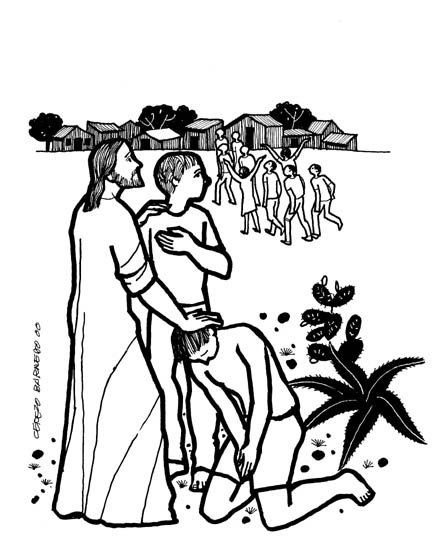
2.  In today’s gospel reading, we get to see what it was like for Jesus to do something for someone else and not get the equivalent of a thank you note.  As in much of Luke, Jesus is on the road from his home in Galilee toward Jerusalem.  On this road, in a border region between Jewish Palestine and Samaria, Jesus comes across a small leper colony.  In the ancient world, communicable skin diseases were a terrible scourge, and people who had these diseases were forced to live in quarantine away from healthy people.  And the quarantine was especially serious for Jewish lepers since the Jewish law exacted strict standards of physical and ritual purity.  Even if a leper recovered from his illness, he could not re-enter Jewish society without first checking with a priest and getting his stamp of approval.  So these lepers were doubly excluded from life:  from day to day interaction with healthy people and any interaction with the ritual life of their religion.  By this time in Jesus’ ministry, it was well known throughout the region that he was a miracle worker—he had healed hundreds if not thousands of sick people, and even these quarantined lepers knew that he was probably their only chance to be cured.  So, when he comes within earshot, they call out for his mercy. 
So, being Jesus, Jesus cures them.  He sends them to be checked out by religious authorities in the temple, and as they turn to go, they discover that they are all better.  And you know how it ends.  Only one comes back to say thank you.  To accentuate how unique, how special, it is that this one is giving thanks, Luke tells that of the ten lepers, only the Samaritan, the foreigner, came back. 

3.  We don’t often think of how Jesus felt.  We are more likely to think of him as all-powerful, or as a perfect example, or as a teacher, or as a character in an ancient story.  But he was a person.  He had feelings.  He could be happy, he could be sorrowful.  And I have no doubt that he could have his feeling hurt.  It had to sting that he had healed ten and only one said thank you.  Now, it was not necessary for the other nine to say thanks—it wasn’t like Jesus took their healing away from them because of their lack of good grace.  But you know and I know that it is nice to hear “thank you.” 
 
4.  It takes a while to learn to express gratitude.  I’m sure this is why our mothers made us sit down and write thank you notes.  We are so oriented to receive and to take that it is all too easy to forgo gratitude altogether.  We can be a lot like the nine lepers.  They’re not all bad.  They had faith in Jesus and his power and his mercy.  And they were good at following directions.  When Jesus tells them to go to the temple and show themselves, they get right to it.  But Jesus is not their drill sergeant.  When he says “frog,” he doesn’t expect people to jump.  The great preacher Barbara Brown Taylor puts it this way: “I know how to be obedient but I do not know how to be in love.”  Oh yeah.  To be grateful is to acknowledge a relationship.  It is to acknowledge the tie between you and God, or you and someone else. 
Author David Steindl-Rast suggests that when we say thank you to God, we are implicitly saying that we are close to God.  He writes, “One who says, ‘Thank you’ to another really says, ‘We belong together.’”  In this sense, expressing gratitude is one way of expressing love. 

5.  Of course, the first step in being thankful is to notice the blessings you have received.  Presbyterian minister Lynne Baab says, “It is truly amazing how many blessings we can notice if we take the time to pay attention.  It changes our heart over time if we try to notice all the ways God is already working, rather than focusing on the ways we want God to act.”  If we spend all our prayer time asking God to do more we can forget to spend time thanking God for what God has already done. 

6.  Perhaps this is why our own worship is based so much on giving thanks.  When we come together to pray, we like to celebrate what God has done and is doing.  Sure, we also try to be obedient to God and God’s desires for our lives.  And we also ask God to intercede on our behalf.  But when we come to worship, we come with thanksgiving and praise on our lips.  We praise God for being who God is, and we thank God for doing the things God does. 
One of the central features of our worship is the sacrament of communion, also known as the Lord’s Supper or the “Eucharist.”  The word “eucharist” means “thanksgiving” in Greek.  And the Great Prayer of Thanksgiving is what we call the prayer that ties the Lord’s Supper together.  In one way, it is a prayer of gratitude before a meal. 
It begins this way:
The Lord be with you.  And also with you.
Lift up your hearts.  We lift them to the Lord.
Let us give thanks and praise.  It is truly right and our greatest joy to give our thanks and praise.
Now, I bet a lot of things give you joy in this world.  The sunshine, the blue sky, spending time with loved ones, meaningful work, etc.  But in this prayer, we say together that OUR GREATEST JOY is to give thanks and praise to God.  It is our greatest joy because in so doing, we recognize and remember that we love God and God loves us.  We remember all the great and merciful acts that God has done for us in history, culminating in the gift of Jesus Christ.  And we are grateful.  We are grateful not because we are such great people with such exquisite manners.  We are grateful because of who God is.  Because God is who God is, it is truly right and our greatest joy to give God our thanks and praise. 

7.  We all need to remember this sacrament, this Great Thanksgiving, and build up personal and community habits of gratitude.  Our Wednesday morning study group recently spent some time considering gratitude as a spiritual discipline.  We discussed what a good idea it would be in our prayer lives to spend more intentional time counting our blessings and saying thanks to God.  There are so many motives for gratitude:  in the creation, in our families, among our friends, in our work—you name it, there are lots of ways God is caring for us and building us up.  Like the Samaritan leper, we ought to turn around and say thanks.  And saying thanks, building up those habits of gratitude, will lead to an even better appreciation of God’s never-ending love.  Theologian Dietrich Bonhoeffer wrote: “Only they who give thanks for little things receive the big things. We prevent God from giving us the great spiritual gifts he has in store for us because we do not give thanks for daily gifts.” 
So, we thank you God for the little things you do for us.  We thank you for this church.  We thank you for our homes.  We thank you for our friends.  We thank you for being with us.  We thank you for Jesus and his love for us.  We thank you and we acknowledge that we depend on you for everything, big and small. 
I would like to close with a prayer that was written by Rev. John Thomas, the president and general minister of the United Church of Christ denomination. 
“Let us pray: Teach us to practice gratitude in our lives that we may honor the graciousness at the center of your creation. Forgive every form of self-centeredness that assumes we are entitled to what we have and make us mindful of every good gift and of every good gift-giver. Thus, may we return again and again to you as those redeemed and renewed by your love rather than our deserving and so experience the joy of your presence that makes us well. Amen.”

Monday, October 4, 2010

Faith to Move

Luke 17:5-10
October 3, 2010 (27th Sunday in Ordinary Time)


1.  Do you remember the story from the book of Exodus about the Israelites wandering around in the desert for 40 years?  It was tough going through those forty years, just one of the many tough times they went through.  If you’ve been listening closely to our Old Testament readings for the last few weeks, you’ve been hearing the sad stories of exile and punishment from the biblical prophets.  Well, anyway, getting back to the Exodus—do you remember that the Israelites were hungry out in the middle of nowhere?  God hears their complaints and gives them manna, which is this sort of flaky sweetbread that settled with the morning dew.  God commanded that each family gather only as much manna as they would need for one day, anything extra would go bad.  And, in fact, those greedy families who hoarded the manna would find that it would not last more than one day—the leftovers would quickly fill with worms and become inedible. 
Naturally, this whole experience with manna has become a powerful metaphor for both Jews and Christians who are trying to remember that God will meet our daily needs.  In the wilderness, the Israelites didn’t need barrels full of manna; they just needed enough to sustain them each day.

2.  The disciples in this morning’s gospel reading want more than what is sufficient for one day.  They say to Jesus, “Increase our faith!”  Wouldn’t that be great?  Wouldn’t it be wonderful if you had so much faith you could store it away for those times in your life when you know you could use an extra boost?  It’s not completely possible to be sure about the tone of Jesus’ response, but I like to think that he laughs at the disciples a little.  He seems to say, “You need more faith like the ancient Israelites needed more manna!  What are you going to do with all this surplus faith?  Do you honestly have a need to plant mulberry trees in the ocean?  Do you honestly have a need to move mountains with the power of your faith?  The last time I checked, the faith that you have was getting you through the day!” 

3.  Like manna, it seems you can’t store up faith.  In fact, the gospel passage seems to suggest that the question is not “How much faith can I have?” but rather is “What is my faith for?”  Professor Kim Long writes, “In this economy, faith is not stockpiled in a storehouse for the working of spiritual wonders, but is lived out as obedience to a just and loving God….[F]aith cannot be measured, only enacted.” 

4.  Back in the late 1800s, there was a famous Methodist revival preacher named Samuel P. Jones.  He did a lot of preaching in Ryman Auditorium, which nowadays is the home of the Grand Ole Opry.  I want to share with you a piece of one of Rev. Jones’s sermons.
[An old church member] says, “I am waiting for faith.”  Yes, you have been waiting forty years for faith.  How much have you saved up?  Like the fellow who had ten bushels of wheat, and was waiting till more grew before  he could sow what he had.  Sow it, and you will have a hundredfold.  By keeping it, you will not get any more, but the rats will eat up what you have.
… “I want to be a blacksmith as soon as I get muscle.”  Why don’t you go at it?  There he stands until at last he has got muscle enough to lift the hammer.  He is “getting it” with a vengeance.  How did you get faith?  By using what you had.  I tell you what tickles me—to hear fellows down praying for faith.  “Lord, give me faith.”  The next time you get any in that way, bring it over and let me see it.  That ain’t scriptural, that talk you are doing now.  Christ rebuked those who prayed for faith.  The trouble with you is not that you need more faith.  You use the faith you have, and then you will get more.  I would as soon pray for sweet potatoes as faith.”
I love that last line!  “I would as soon pray for sweet potatoes as faith”!

5.  Rev. Jones is surely right.  Use your faith if you want more of it.  This is the gist of the story Jesus tells the disciples when he asks if the master should invite the slaves in for dinner after a hard day’s work.  The answer, at least in Jesus’ day and age, was “no, I would have them continue serving me since they are meant to serve.”  Jesus concludes, “So you also, when you have done all you were ordered to do, say… ‘we have done only what we have ought to have done.’”  In other words, we must not forget that God is our God, and we are here to serve.  We don’t need more faith, or an increase, because we have what we need from God to serve right now.  Faith, if we can talk about it increasing at all, increases in service.

6.  And how do we know this?  German theologian Margit Ernst-Habib  says that we need to “understand the faith talked about [in this passage] as Christian, not in the sense of the faith of the Christians, but in the sense of the faith in Christ that mirrors the faith of Christ.”  You see, when Jesus tells us we need to serve if we want to have faith, he is not just telling us what to do.  He himself models this.  Jesus Christ is the Lord who serves.  He serves the poor, he serves the sick, he serves the downcast, he serves the lonely, he serves the stranger, he serves you, and he serves me.  This is the faith to move.  Faith, in a very real sense, can hardly be thought of as a noun, but would better be considered a verb tied very closely to serving our God and neighbor. 

7.  There is a very famous line in a poem by Spanish poet Antonio Machado.  It is:  “Caminante, no hay camino; se hace camino al andar.” Or, “Traveler, there is no road... it's made by your own footsteps.”  So we move in faith. We reach out and serve.  We make the road ahead of us by walking and serving.  And that’s what actually constitutes our faith!  We can’t stockpile God’s gifts.  They are for sharing right now. 
On the night before his crucifixion, Jesus served the Last Supper to his disciples.  Because of that night, we continue to come together around this table to be with him and be strengthened by his own body and blood.  As part of that evening, Jesus stripped down to his undergarments, got down on his hands and knees, and like a slave washed the disciples’ feet.  If you want an increase in faith, this story is a great place to start.  We believe that the fullness of God was pleased to dwell in the man Jesus.  And this Jesus behaved as a slave to his followers.  And so, this meal, this bread and wine, remind us that we are to serve.  We are to reach out and care for others, to remember their dignity, and to remember that they, too, are beloved by God. 
So on this World Communion Sunday, we give thanks to God that our servant Lord taught us that faith is to give your life.  May we be strengthened at this table to move, to serve, and so to have faith.
Let us pray: 
By your will, O God,
we go out into the world
with the good news of your undying love,
and minister in the midst of human need
to show wonders of your grace.
We pray for men and women
who minister for you around the world.
May all Christians be strengthened by our mutual concern,
and supported by the sharing of our gifts.
Let us not be discouraged by doubts or other barriers
but make us brave and glad and hopeful in your word;
through Jesus Christ our Lord.  Amen.

Monday, September 27, 2010

The Invisible Man

Luke 16:19-31
September 26, 2010 (26th Sunday in Ordinary Time)
Rev. Brett Hendrickson


1.  Some of Jesus’ parables are so familiar:  the Prodigal Son, the Good Samaritan.  Some not so much.  Here we’ve got one of the less popular, but it’s a goody!  There is so much detail and humor in these verses from the gospel reading, and the characters—though a bit caricatured—are true enough to life.  Of course, there’s the rich man.  He’s not a bad guy, he’s just privileged.  He was born that way, with a silver spoon in his mouth.  Then there’s Lazarus, the only person in a parable to have a particular name.  He’s the opposite of the rich guy.  Instead of fine clothing, he wears nothing but his own worn out skin, which itself is full of sores.  Instead of eating sumptuous feasts, he eats nothing but what he can beg.  Instead of being greeted by the beautiful people, stray dogs disgustingly lick him while he’s down.  Then in the story, we have the patriarch Abraham, who seems to be in charge of something like heaven.  He’s more or less to this paradise as is St. Peter at the pearly gates in our jokes about heaven.  Across an impassable chasm from heaven, there is a place called Hades, which is full of fire and torment.  And, strangely, both the suffering ones in Hades and the comfortable ones in the bosom of Abraham can see each other. 

2.  Remarkably, and of key importance for the parable, the rich man never sees Lazarus when Lazarus is a fetid beggar outside the gates of his compound.  He never sees him when he is coming and going from his dates with the rich and famous or from his jaunts to the finest shops.  The rich man doesn’t see Lazarus until his backside is being warmed by the fires of Hades.  Then he sees Lazarus living the comfortable life up in paradise, and he somehow conjures up his name.  But he still doesn’t speak to him directly.  Instead, the rich man, who is used to giving orders, tells Abraham to send the poor Lazarus to come and refresh him in Hades.  And when that is refused, he asks that poor Lazarus be removed from the paradise that he so richly deserves after his miserable life, and be sent back to earth to haunt the rich man’s brothers and scare them straight.  This request is also refused.

3.  The natural sense of the parable is that both Lazarus and the rich man get what’s coming to them, and so perhaps it is also natural that we are likely to feel sympathetic with Lazarus and even laugh a little bit about the rich man’s hubris and comeuppance.  But, I think that if we are honest, we need to swallow our laughter and remember that it is far more reasonable in this day and age in this rich country to remember that we are more like the rich man.  There’s a website on the internet called Global Rich List.  On this site, you can enter what your income is, and it tells you where you stand financially in the whole world.  I entered mine and my wife’s income into the site and found out that together, we are the 49,322,169th richest people in the world!  So, pretty far down the list?!  Not so.  It turns out, even at 49 millionth place, we are in the top 0.82% richest people in the world!  In other words, in a group of 100 random people around the world, I would be the richest.  I imagine those 100 people in a line behind me, and I know that I can see the 98th and 97th richest people right behind me.  If I really try, I can even see down to probably the 90th richest person.  But I can’t even see the really poor people at the end of the line.  They are like Lazarus to me.  They are completely outside of my vision and my experience.

4.  That’s the problem right there.  Too many people live in this world completely outside of our sight.  Because of poverty and other sinful barriers, we cannot see them.  The terrible truth of this situation is what inspired Ralph Ellison’s famous novel The Invisible Man.  The protagonist of the book is a nameless African American man who has been made metaphorically invisible by the society he lives in.  The narrator says, “I am an invisible man. No I am not a spook like those who haunted Edgar Allen Poe: Nor am I one of your Hollywood movie ectoplasms.I am a man of substance, of flesh and bone, fiber and liquids- and I might even be said to possess a mind. I am invisible, simply because people refuse to see me.”  It’s the gospel story all over again. The rich man in Jesus’ parable could have seen the poor, sore-covered Lazarus outside his gate, but he had no reason to do so, and so he simply was blind to the suffering, downtrodden man before his gate. 

5.  What is perhaps worse is when the rich like us go out of our way to not see the poor and the suffering.  I live in west Belleville not far at all as the crow flies from the slums of East Saint Louis.  The quickest way for people in our part of town to get to downtown St. Louis is to take Illinois 15 west and then navigate through the blighted and burnt out neighborhoods of East St. Louis to the Poplar Street Bridge.  But if you take this route, there is almost no traffic.  All of us, myself included, find it better, safer, easier, less terrible, to take the longer way around on the 255 up to I64 thus completely skirting the devastation of our neighboring city.  I would say we Bellevillians must  be a pretty rotten bunch to act this way, but all over the country, cities like Belleville, and like Alton, have found ways to route better off people away from poor people.  In this awful circumstance, we are willfully blind.  We don’t see because we do not want to see. 

6.  The upshot of Jesus’ parable, sadly, for the rich man is that there’s not really anything new to say.  The rich man desperately wants Lazarus to be sent back to his family, with the notion that a specter from beyond the grave would at last open their eyes.  That an apparition would do the trick to remind them of their religious obligations to care for the poor.  But Abraham says no.  He says there is no new word to give on this.  It’s all been said before.  The law, the prophets.  It’s all in there:  take care of the poor, comfort the afflicted, tend to the suffering.  And if you didn’t hear the old, old, story, not even the ghost of Lazarus will turn you around.  I guess I don’t really have a new word either.  We all know that we Christians cannot bumble through life with blinders on.  We all know that the poor, the imprisoned, the oppressed, the foreigner are all our specific responsibility.  What more is there to say?  If we haven’t listened to all that, and we persist in our willful blindness, not even seeing a resurrected man will turn us around once it’s too late.
But, it’s not too late.  That’s why Jesus tells the parable in the first place.  He wants those who hear him to do something now.  We are still able to open our eyes and clean out our ears.  We are still able to repent and start seeing.

7.  And this need to see the poor, and to serve the poor, and to be one in Christ is urgent.  An old saying attributed to the British stateman William Gladstone is “justice delayed is justice denied.”  There is no time to wait.  The urgency of poverty in this world is extreme.  Jesus’ parable about the rich man and Lazarus suggests that it is not our certitude about God and the afterlife that will ultimate motivate a change in our behavior.  Instead, we will be motivated by the certitude that suffering people exist in this world, and we need to see them and care for them and help them find justice now, before it is too late for us and too late for them. 

8.  It’s like the campaign that you see around Illinois with the big signs that say “Start Seeing Motorcyles!”  We need to start seeing the poor.  Let me give you some suggestions on how to do this. 
  • Pray.  Pray that God open your eyes to the suffering of your fellow human beings.  Pray that God give you a compassionate spirit and the energy to serve.
  • Talk.  Talk to your friends and neighbors.  What are they doing to help others?  Can you help them?  Find out from them why they got interested in the work they do to help others.
  • Reflect.  Think about what God has given you.  What are you good at?  What are your interests?  Is there some way that you can both help the Lazaruses in this world AND use your God-given gifts and interests.  Do you like to read?  Read to the blind.  Do you like to garden?  Find a way to beautify blighted areas.  Do you like children?  Become a mentor.
  • Finally, make a commitment.  When it comes to helping the poor, to providing justice now rather than later when it is too late, the important word is this:  something is better than nothing.  You don’t need to be the next Martin Luther King.  You need to do something.  Do it here at the church, or do it with another group.  It is not possible to be a rich Christian, and we are all rich in some way, without serving the poor.  Let me conclude with words from the passage in 1 Timothy that we heard this morning:  “As for those who in the present age are rich, command them not to be haughty, or to set their hopes on the uncertainty of riches, but rather on God who richly provides us with everything for our enjoyment. 18They are to do good, to be rich in good works, generous, and ready to share, 19thus storing up for themselves the treasure of a good foundation for the future, so that they may take hold of the life that really is life.” 
Brothers and sisters, Amen.