January 30, 2011 (4th Sunday in Ordinary Time)
1. A new semester has started for college students and for college instructors, and so I am back up at Lewis & Clark teaching World Religions. My practice is to begin the semester with a few classes on the ancient religion of India, Hinduism. If you push people to name what they know about Hinduism, they may be able to come up with many gods, some of them with many arms and legs, pilgrimages to the Ganges, the practice of yoga, reincarnation, and above all, karma. Karma is one of the driving concepts for Hindus, the idea that your good deeds as well as your misdeeds will be revisited upon you as rewards or punishments either in this life or the next.
2. Most people, Hindu or not, have at least a small belief in karma. Most people are prone to believe, and even to say, “what goes around, come around.” One of the ways I help students understand the concept of karma, for better or for worse, is to talk about a sitcom that aired on NBC a couple of years ago—it was called “My Name Is Earl.” The premise of the show was that a petty criminal, Earl, won a lot of money in the lottery. But minutes after winning, he is struck by a car and hospitalized in traction. During his recovery, he realizes that it was karma that made the car run him over. He had hurt so many people in his life of crime that karma could not allow him the good fortune of winning the lottery. So in his hospital bed, he makes a list of all the bad things he had done to other people and resolves to make things right with every last one of them. In this way, he hopes to appease karma so that he can keep the lottery money.
This kind of karma we can all sort of be on board with. We like to think that if we treat people well, we too will be treated well. And we like to think, even when the evidence is against it, that bad people who exploit others for their own benefit, will “get theirs in the end.”
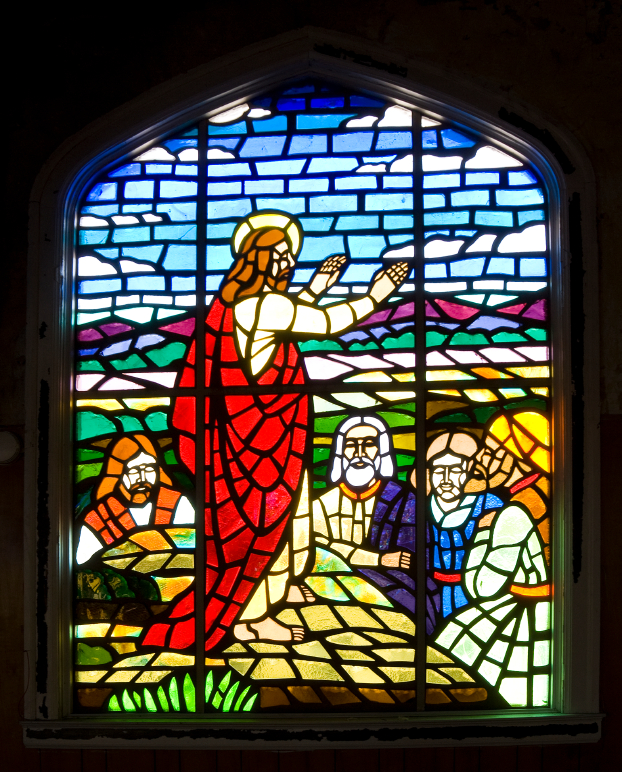 3. With the prevalence of this idea in our culture, it is not hard to imagine that the passage we heard from Matthew this morning—the famous Beatitudes—is a religious justification of karma. So for example, try to make peace so that you can be a child of God. Or try to be meek, so that you can inherit the earth. Or, try to be the kind of person who wants righteousness so that you can be filled up with good things. “You scratch my back and I’ll scratch yours.” In this way, the Beatitudes become a set of moralistic platitudes. Sort of a religious carrot-and-stick. If you are good person, you will win one of God’s lovely premiums. And if you are not good, well, let’s not even go there! Lest you be struck with the stick of bad karma, you better do the good that the platitude, oops I mean beatitude, mandates!
 4. The thing is, of course, that the Beatitudes are not a karma system. They are not based on meting out rewards to the holy and punishments to the wicked. They are not “What goes around, comes around.” They are not pieces of advice for our behavior.
They are, instead, a clear description of God’s kingdom. In grammatical terms, they are not the future tense or the subjunctive mood. They are indicative. They describe how things are right now. They describe, they do not prescribe.
So, when Jesus says, “Blessed are the poor in spirit, for theirs is the kingdom of heaven,” he is actually pointing out what is real in God’s reality. In the reality of God’s kingdom, the poor in spirit have the kingdom of heaven. Likewise, those who mourn ARE comforted. Those who are pure in heart DO SEE God.
We are likely to think of these beatitudes only in the future tense because we are so good at not seeing God’s reality. We are far more likely to see our own sin-drenched reality wherein the mourning are not comforted, where the meek get run over, where the poor in spirit are emotionally needy people that we would rather avoid, where those who make peace are accused of being unpatriotic, where those who show mercy are considered too soft or too lenient. We are ok with these beatitudes as long as they are limited to some future time. We are ok with them as long as we can say that they are holy ideals but hardly realistic descriptors of the here and now.
5. But the truth of the gospel is that God has preferences. God has made choices between us. And while God loves us all, God is quite clear over and over again that God chooses the meek, the poor, the merciful, the peacemaker. Theologian Marcia Riggs explains, “Those who receive God’s favor are not the privileged classes of the Roman Empire or the Jewish establishment. The Beatitudes are spoken to those groups whom God deems worthy, not by virtue of their own achievements or status in society, but because God chooses to be on the side of the weak, the forgotten, the despised, the justice seekers, the peace makers, and those persecuted because of their beliefs.”
Preacher Dylan Breuer further elaborates:
Jesus gathers in all of these people who are completely bereft and without honor in their culture's eyes, and he gives them two gifts which more than compensate for their very real losses.Jesus gives them honor. In front of all the crowds, Jesus ascribes honor to them, declaring that these are the people whom the God of Israel honors. Their human fathers may have disowned them, but they are children of the God who created the universe, to whom all honor belongs.And that brings up the second gift that Jesus gives them: He makes them family. They are children of one Father, and that makes them brothers and sisters. They will never be bereft in a community that sees themselves as family, and that cares for one another in ways that show that they take that family relationship with utmost seriousness.
6. So if the suggestion is that the Beatitudes are not Platitudes, which is to say that they are not simple sayings of cosmic cause and effect, then where do we find our selves in them? If the Beatitudes are instead a description of God’s preferences for the powerless, the suffering, the grieving, and the persecuted, where do we find the good news?
Well, first, the Beatitudes are recorded as the very first sayings in Jesus’ famous “Sermon on the Mount.” And notice that the sermon comes early in the gospel—it’s only in chapter 5. Jesus has barely begun his earthly ministry at this point. He’s been baptized, he’s gathered a few disciples, and he’s gained a following by performing some miraculous cures, but this is his first extended proclamation. He comes into his own by teaching that God blesses those who really need to be blessed. Before he gives any instruction, and directions as to how we ought to act, he first tells us that when we need it most, we are blessed by God. Before telling us to get our lives in order, before telling us to take up the cross and follow him, before commissioning us to be his hands and feet on earth, our Lord Jesus tells us that God’s reality is one where we are free to care for each other in meekness, in grief, with peace, and with spiritual simplicity. Jesus tells us that we are blessed.
We should take this as very good news. While none of us perhaps counts as the poor of the earth, every one of us has need of God’s blessing and care. Every one of us needs to find himself or herself not in the anxiety-system of the world but instead in the reality of blessing that is the kingdom of God. God blesses first. It is not karma. It is the gracious blessing of a God that surpasses all our expectations with steadfast love.
7. So know that, before all else, you are blessed. You are blessed, not because of the great things you do, not because of the great deeds you have accomplished, not because of the house and family and health and all those things we normally call “blessings.” You are blessed because God who loves you has chosen you as you are. Amen.


