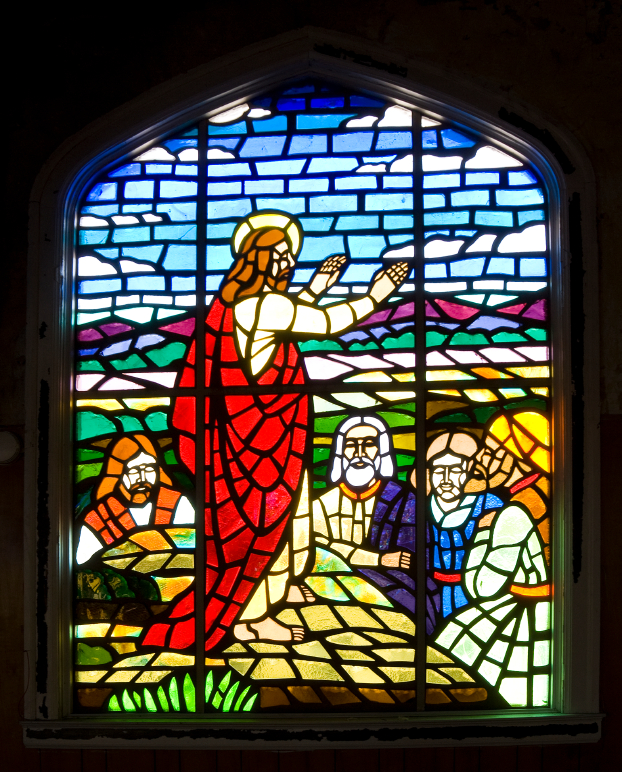
Monday, February 7, 2011

Salt and Light

Matthew 5:13-20
February 6, 2011 (5th Sunday in Ordinary Time)


1.  “I can remember when this church was full!”
“I can remember when there were kids all over this place.” 
“I sure wish more people came to church—there’s so much empty space.”
These sorts of statements of longing and desire are pretty common at mainline Protestant churches across the United States today.  By mainline Protestant, I’m referring to the denominations of the old ruling class in this country:  the Presbyterians, the Episcopalians, the Congregationalists, the Lutherans, and to a lesser extent, the Methodists and the Baptists. 
As we both know, these denominations have been shedding members over the last few decades.  Times have changed, and being a church member just doesn’t have the cache that it used to have in the business and civic world, and so we aren’t as full as we used to be.  When we say we want more members, we sometimes mean that we want Protestant Christianity to have the same cultural and political force that it once did. 
But, have you ever thought that the Protestant Church today is not that different from the very first church that formed after Jesus’ ascension to heaven?  That church was not politically powerful.  It had few members.  It wondered where it’s place was in a world that often seemed at odds with the church. 
When we hear Jesus’ Sermon on the Mount, first recorded by Matthew to guide and comfort a struggling church, maybe we too can hear it as a word of comfort and guidance to us, also a church that is not powerful.  How are Christians who are a minority of the culture supposed to live in the world?  That is the very same question the first Christians were asking themselves—we might be asking ourselves the same thing.

2.  Jesus tells them that they are to be salt and they are to be light.  Put aside the modern medical wisdom that says too much salt is bad for you and remember that salt is what makes food taste good.  Salt is the principal seasoning.  It enhances other flavors.  And it preserves food, keeping it from going bad.  Preacher John Brokhoff reminds us that, “Without salt our hearts would not beat, blood would not flow, and muscles would not work properly. Before birth a baby develops in a saline solution. Accident victims may receive a salt solution intravenously. In Roman times salt was so precious that it was used, at least in part, to pay workers. The word "salary" comes from the Latin salarium, a word for salt. A person not worth his or her salt is one not worthy of wages.” 
Another biblical commentator writes that salt “elicits goodness.”  I really like that.  Christians, who are to be salty people, are to be the kind of people who elicit goodness in the world.  We are to bring out the best qualities of the people we meet, and we are to work for goodness in our societies.  If something is good, we make it better.  If something is bland, we give it flavor.  If something is in danger of going bad, we preserve it for use. 

3.  And Jesus tells us to be light.  When saltiness has done all it can, we need to shine light on the dark places.  We can’t assume that we will always be able to improve what we find.  We may also need to step in shine the light of God on places in this world that need to be illumined.  This kind of light can both light up injustice and oppression so that redress can be made, or it can spotlight cases of remarkable mercy and kindness.  Our Lord Jesus himself is often understood as light—he is the light in the darkness and the darkness cannot overcome it.  Likewise, we salty Christians are also to be light, the reflected light of God in a world that needs to see God’s glory.

4.  Jesus preaches to his followers, then and now, that they should be salt and light.  And Jesus makes specific mention of a group that is not getting this right—he singles out the Pharisees as ones who are not making the cut.  Theologian Edwin van Driel points out that the Pharisees’ religious strategy was to withdraw into a religious enclave where they could live out their little formulas of faithfulness without having to interact with the Romans or any other challenging force in their world.  As long as they could be left alone to practice their rituals and traditions in peace, they could claim to be holy and righteous before God.  For Jesus, however, this was a failed approach to faithfulness.  This was like salt that had lost its usefulness, or even worse, it was like a light that had been hidden under a bushel basket.  It didn’t illumine anything.  In response to this clubbishness, this clannishness, this refusal to interact in faith with the world as salt and light, Jesus preaches his sermon.  He calls his followers to leave the confines of their little religious world and be flavor and shining goodness for a world in need. 

5.  And that brings us to the unavoidable question.  Does the world need Christians?  Life as we know it cannot exist without salt and light.  Are we absolutely necessary in that way?  Do we bring something intrinsically essential to the world?  We sure do when we carry the flavor and light of Jesus Christ into a hurting and hungry and dark world. 
To make it an even harder question: Does the world need First Presbyterian Church?  Are we salt and light?  I know for a fact that many of you have an important community of friends and loved ones in this church.  And for that fact alone, you might find that the world does need this church.  But as Archbishop William Temple famously said, “The church is the only organization on earth that exists for those who are not its members.”  We are called by Christ to elicit goodness in the world and to shine God’s light.  We do this, but there is always the opportunity to bring more light. 

6.  Older mainline congregations like this, those that can remember the glory days, are often content to recall light that used to shine.  We wonder why we have declined, and in our heart of hearts, we may even wonder if we did something wrong to be in the state we are in today.  Why are our pews so much emptier than they used to be? Psychologists teach us that it is very difficult to get your confidence back once it has been shaken by setbacks or even insults.  We’ve heard so much that our church is shrinking and that it is graying.  We have heard that we are irrelevant or washed up.  We have heard that we are too set in our ways to meet the world with fresh flavor and bright beams of light.  We’ve heard all that so much that we have started to believe it. 
Professor David Lose writes, “Psychologists suggest that for every negative message elementary-aged children hear about themselves, they need to hear ten positive ones to restore their sense of self-esteem to where it had been previously.”  Lose suspects, and I agree, that adults are not that different from children in this regard.  If we hear that we are bad, we need to have it reinforced for us ten times over that no, we are not bad.  We are salt and light.  We are salt and light.  We are salt and light. 

7.  I once brought a group of youth to a church camp weekend event for Middle School students.  They keynote speaker, a young Presbyterian minister, stepped off the stage carrying a microphone.  He walked up to a girl and had her stand up.  He asked her name.  “Stephanie” she said.  Then he said, “Stephanie, you are God’s gift to this earth.”  He walked to another kid.  “What’s your name?”  “Josh.”  “Josh, you are God’s gift to this earth.”  And in this way he approached several others, always saying that each one was God’s gift to this earth.  Perhaps it’s not a bad message for us here today.  We are God’s gift to this earth.  God gave First Presbyterian Church to this earth, and each of you gathered here, to be salt and light.  You’ve heard of the person who can light up a room.  Let us be the church that can light up the world.  Let your light shine!  Let it shine now.  The world still needs you.  Amen.

Monday, January 31, 2011

Beatitudes--Not Platitudes

Matthew 5:1-12
January 30, 2011 (4th Sunday in Ordinary Time)


1.  A new semester has started for college students and for college instructors, and so I am back up at Lewis & Clark teaching World Religions.  My practice is to begin the semester with a few classes on the ancient religion of India, Hinduism.  If you push people to name what they know about Hinduism, they may be able to come up with many gods, some of them with many arms and legs, pilgrimages to the Ganges, the practice of yoga, reincarnation, and above all, karma.  Karma is one of the driving concepts for Hindus, the idea that your good deeds as well as your misdeeds will be revisited upon you as rewards or punishments either in this life or the next. 

2.  Most people, Hindu or not, have at least a small belief in karma.  Most people are prone to believe, and even to say, “what goes around, come around.”  One of the ways I help students understand the concept of karma, for better or for worse, is to talk about a sitcom that aired on NBC a couple of years ago—it was called “My Name Is Earl.”  The premise of the show was that a petty criminal, Earl, won a lot of money in the lottery.  But minutes after winning, he is struck by a car and hospitalized in traction.  During his recovery, he realizes that it was karma that made the car run him over.  He had hurt so many people in his life of crime that karma could not allow him the good fortune of winning the lottery.  So in his hospital bed, he makes a list of all the bad things he had done to other people and resolves to make things right with every last one of them.  In this way, he hopes to appease karma so that he can keep the lottery money. 
This kind of karma we can all sort of be on board with.  We like to think that if we treat people well, we too will be treated well.  And we like to think, even when the evidence is against it, that bad people who exploit others for their own benefit, will “get theirs in the end.” 

3.  With the prevalence of this idea in our culture, it is not hard to imagine that the passage we heard from Matthew this morning—the famous Beatitudes—is a religious justification of karma.  So for example, try to make peace so that you can be a child of God.  Or try to be meek, so that you can inherit the earth.  Or, try to be the kind of person who wants righteousness so that you can be filled up with good things.  “You scratch my back and I’ll scratch yours.”  In this way, the Beatitudes become a set of moralistic platitudes.  Sort of a religious carrot-and-stick.  If you are good person, you will win one of God’s lovely premiums.  And if you are not good, well, let’s not even go there!  Lest you be struck with the stick of bad karma, you better do the good that the platitude, oops I mean beatitude, mandates! 

4.  The thing is, of course, that the Beatitudes are not a karma system.  They are not based on meting out rewards to the holy and punishments to the wicked.  They are not “What goes around, comes around.”  They are not pieces of advice for our behavior. 
They are, instead, a clear description of God’s kingdom.  In grammatical terms, they are not the future tense or the subjunctive mood.  They are indicative.  They describe how things are right now.  They describe, they do not prescribe. 
So, when Jesus says, “Blessed are the poor in spirit, for theirs is the kingdom of heaven,” he is actually pointing out what is real in God’s reality.  In the reality of God’s kingdom, the poor in spirit have the kingdom of heaven.  Likewise, those who mourn ARE comforted.  Those who are pure in heart DO SEE God. 
We are likely to think of these beatitudes only in the future tense because we are so good at not seeing God’s reality.  We are far more likely to see our own sin-drenched reality wherein the mourning are not comforted, where the meek get run over, where the poor in spirit are emotionally needy people that we would rather avoid, where those who make peace are accused of being unpatriotic, where those who show mercy are considered too soft or too lenient.  We are ok with these beatitudes as long as they are limited to some future time.  We are ok with them as long as we can say that they are holy ideals but hardly realistic descriptors of the here and now.

5.  But the truth of the gospel is that God has preferences.  God has made choices between us.  And while God loves us all, God is quite clear over and over again that God chooses the meek, the poor, the merciful, the peacemaker.  Theologian Marcia Riggs explains, “Those who receive God’s favor are not the privileged classes of the Roman Empire or the Jewish establishment.  The Beatitudes are spoken to those groups whom God deems worthy, not by virtue of their own achievements or status in society, but because God chooses to be on the side of the weak, the forgotten, the despised, the justice seekers, the peace makers, and those persecuted because of their beliefs.”
Preacher Dylan Breuer further elaborates:
Jesus gathers in all of these people who are completely bereft and without honor in their culture's eyes, and he gives them two gifts which more than compensate for their very real losses.
Jesus gives them honor. In front of all the crowds, Jesus ascribes honor to them, declaring that these are the people whom the God of Israel honors. Their human fathers may have disowned them, but they are children of the God who created the universe, to whom all honor belongs.
And that brings up the second gift that Jesus gives them: He makes them family. They are children of one Father, and that makes them brothers and sisters. They will never be bereft in a community that sees themselves as family, and that cares for one another in ways that show that they take that family relationship with utmost seriousness.

6.  So if the suggestion is that the Beatitudes are not Platitudes, which is to say that they are not simple sayings of cosmic cause and effect, then where do we find our selves in them?  If the Beatitudes are instead a description of God’s preferences for the powerless, the suffering, the grieving, and the persecuted, where do we find the good news?
Well, first, the Beatitudes are recorded as the very first sayings in Jesus’ famous “Sermon on the Mount.”  And notice that the sermon comes early in the gospel—it’s only in chapter 5.  Jesus has barely begun his earthly ministry at this point.  He’s been baptized, he’s gathered a few disciples, and he’s gained a following by performing some miraculous cures, but this is his first extended proclamation.  He comes into his own by teaching that God blesses those who really need to be blessed.  Before he gives any instruction, and directions as to how we ought to act, he first tells us that when we need it most, we are blessed by God.  Before telling us to get our lives in order, before telling us to take up the cross and follow him, before commissioning us to be his hands and feet on earth, our Lord Jesus tells us that God’s reality is one where we are free to care for each other in meekness, in grief, with peace, and with spiritual simplicity.  Jesus tells us that we are blessed. 
We should take this as very good news.  While none of us perhaps counts as the poor of the earth, every one of us has need of God’s blessing and care.  Every one of us needs to find himself or herself not in the anxiety-system of the world but instead in the reality of blessing that is the kingdom of God.  God blesses first.  It is not karma.  It is the gracious blessing of a God that surpasses all our expectations with steadfast love.

7.  So know that, before all else, you are blessed.  You are blessed, not because of the great things you do, not because of the great deeds you have accomplished, not because of the house and family and health and all those things we normally call “blessings.”  You are blessed because God who loves you has chosen you as you are.  Amen.

Monday, January 24, 2011

At Cross Purposes

1 Corinthians 1:10-18
January 23, 2011 (3rd Sunday in Ordinary Time)


1.  Jesus once said, “Wherever two or more are gathered, I am there with them.”  This saying has led to a couple of pretty pointed jokes.  My favorite is, Wherever two Presbyterians are gathered, there will be at least three opinions.”  And it’s not just Presbyterians—Christians in general have a terrible time agreeing on things.  Churches, ostensibly places of worship and service, are hotbeds of argument and disagreement.  Lest we think that this is a modern-day phenomenon, we have Paul’s first letter to the church at Corinth to show that congregations have been fighting with each other since the very dawn of our religion. 
Paul writes his letter to the Corinthians because he has heard through the grapevine that they have been fighting with each other.  While we can’t be 100% positive of the cause of their conflict, it seems that different factions have been forming in the church based on people’s commitments to especially gifted preachers.  These Corinthian Greeks, who had long valued flowery rhetoric, have been sweet-talked by the honey-tongued early preachers.  Then, to drive it home, some had the opportunity to be baptized by their preacher of choice.  And so they would brag:  I belong to Paul, I belong to Peter, I belong to Apollos, and so on.  It reminds me of when I was in the fifth grade.  A little boy in my class asked me where we went to church and I said the Presbyterian Church.  He said, without guile, “You ought to go to the Baptist Church.  We’re closer to God!” 

2.  I laugh at what my little friend said to me now.  But the truth remains, and I know it all too well:  different churches and factions in the greater Christian Church continue to fight and disagree and consider themselves more holy or more correct.  And, within every congregation of Christians, of any denomination, there are conflicts and factions and ill will one towards the other.  Some of the reasons for these conflicts are “religious” while others have to do with personalities, political disagreements, and sometimes the smallest petty things.  As I was preparing this sermon, I realized that Paul was an outside observer of the church in Corinth.  He could see their disagreements with some objectivity and thus give them some pretty straight advice.  I wondered, then, if First Presbyterian Church of Alton were observed from the outside by someone like Paul, what would he or she say to us about divisions and disagreements in this congregation?  What squabbles or differences of opinion or disagreements would be highlighted in his or her letter to us?  Since I’ve been here, I personally feel that some conflicts in this church have healed to a great extent.  But we must be on our guard.  And the problem, as we see from 1 Corinthians, is not mere disagreement between people of good will.  That kind of disagreement is part of the rich human experience.  The problem, rather, is when these disagreements lead to factions in the church.  When some people band together and compete against other people, we have to ask with Paul:  “Has the cross been divided?”  When I got here to this church, I read reports and comments from the mission study.  Some comments, sadly, suggested that there were factions in this congregation that had stooped even to making threats to leave the church if certain decisions were made.  Like I said, I think a lot of healing has occurred during the past two years, but this kind of competition divides the cross.  When we are at cross purposes we ignore the purpose of the cross. 

3.  The Greek word for household is “oikoumene.”  The Christian Church quickly adopted this word to refer to the larger Christian household around the world.  Early Christians and Christians today have affirmed that we belong together.  This word “oikoumene” is the root for at least two English words today.  The first is “ecumenical,” which of course refers to interdenominational cooperation.  The ecumenical movement seeks out ways for the world’s Christians to work together.  But the other word from oikoumene, which is more provocative, is “economy.”  The Greek oikoumene, or household, is the root for understanding economy, or how we function with the resources that we have at our disposal.  Our economy is our system of assigning value.  For example, in  a monetary economy like ours, we have agreed together to give value to little green papers in our wallets and purses.  But in God’s economy, what creates value?  In God’s oikoumene, household, economy, on what do we agree that ties us together.  Professor of New Testament Daniel Kirk writes, “We discover in 1 Corinthians that the cross creates its own economy. The cross transforms the value of our actions and status. Because of the cross we must learn to view the world differently.” 

4.  So what is the value of the cross?  If we were to form our household, our economy, on the value of the cross, what would that value be?  Partisanship in the church, as Paul says, “empties the cross of its power.”  How so?  Because the cross should be what unites all of us together.  It should be our central focus.  It should be our common currency.  And the cross means:
  • Self-sacrificial love.  The cross means putting aside your own need to be right or to have power or to be in the right group.  And it means joining Christ in caring more about love for others than consolidating your own position.  This goes for life in the church just as much as it goes for life in your family.  The cross revalues how married people treat each other, how friends see each other, and even how political and religious opponents carry out their business.
  • Giving of yourself to others not out of a spirit of obligation or victimhood or self-serving martyrdom but out of joy and thanksgiving for the community of love that God has given us.  No greater love is this than to lay down one’s life for one’s friends.  Likewise, as in Corinth and in Alton, no greater love than to be united in the cross of Christ in the church, despite differences of opinion or emphasis.
  • An invitation to a whole new way of life.  Saint Augustine famously wrote that there are two cities,  the earthly city and the city of God.  We must, by the power of the cross, find our citizenship in God’s city rather than the back-biting, coercive, anxiety-producing cities and economies of human life.  We are called by Christ to rely fully on his cross. 

5.  And let’s not be mistaken.  It’s ok for us to disagree with each other.  We can be Democrats and Republicans.  We can Cardinals and Cubbies.  We can be in love with traditional worship and we can be attracted by other forms of praise.  We can be conservative and we can be liberal.  We can even have varying visions for the future of this congregation.  But we can’t be partisan.  We can’t say that those kinds of issues will decide whether we stay or go from the church.  Again, Professor Kirk writes, “For Paul, the ramifications of party spirit are nothing less than a denial of the gospel itself. The story says that Christ is crucified, and when we act as though anything else (or anyone else) defines who we are then we deny the story of our salvation.”  We are people of the cross.  We are to be of one mind and one purpose, and that purpose is the cross of Jesus Christ. 

Let us pray:
Holy God, help us to love each other with the same love that you have for us.  Unite us in mission even as you bless us each with unique gifts and interests.  Let all who witness us know that we are one in you.  By the power of the name of Jesus.  Amen.

Monday, January 10, 2011

Now Hiring, Will Train

Matthew 3:13-17
January 9, 2011 (Baptism of the Lord)


1.  When I was a little boy, like most little boys, I loved to watch my father shave his whiskers.  I liked it so much that my folks bought me a little toy shaving set.  It had a little fake can of shaving cream, a hand mirror, and a plastic razor (of course with no blade!).  If he was in the mood and I was lucky, my dad would give me some actual shaving cream—not just the pretend stuff—and I would take my toy razor and wipe the shaving cream off just like an adult.  Shaving was fun!  Nowadays, if I could get away without ever shaving I would!  Come to think of it, I also had a toy lawnmower, and believe you me, lawn-mowing is no longer a fun game!  But you know, my kids have these kinds of toys too.  They have a toy vacuum cleaner, and a toy kitchen, and other toys that are based on real, not so fun, adult work.  And so kids play house or play school or play other kinds of adult work settings.
If you watch nature programs, you know that it’s the same with animal babies.  When kittens pounce on each other, they are learning hunting skills for when they are older.  And when fawns bounce around and play, they too are learning the agile movements of their mothers and fathers to escape predators.
As children, it would seem we play to become good versions of our elders.  We practice skills when we pretend. 

2.  Baptism is a bit like this.  When we splash in the water, when we play with a wash basin in the middle of a church, or go out to a river, or dunk ourselves in a tub as part of our worship, we are practicing for a very big and very serious job.  In the Presbyterian Church, we believe that baptism:
  • initiates us into the church;
  • bestows the promise of God’s grace upon us;
  • assures us that God forgives our sins;
  • and calls us to a life of Christian service and fulfillment.
In other words, baptism both marks our entrance into the Christian community and helps form us for the work we will need to do once we are Christians.  We could hang a sign on the baptismal font that read: “Now Hiring, Will Train.”  The promises we make for ourselves and for the care of others in baptism are playful rehearsals of real commitments in the mature years of our faith. 

3.  So, since baptism is about neophytes getting ready for the big time, it is disconcerting to us—just as it was to John the Baptist—that Jesus shows up to get baptized in the Jordan River.  John realizes as soon as he sees Jesus that he, John, is out of his depth.  He stutters, “I need to be baptized by you, and do you come to me?”  Compared to Jesus, John is the little boy with a can of fake shaving cream.  He is still in training—why would he be called on to baptize the master? 
This scenario of tension between the Lord and the follower is one that is utterly commonplace for the Christian.  We all live in this tense place where we know that Jesus is Lord and King and at the same time we know that we are supposed to be like him.  He sits on the right hand of God the Almighty and is himself part of the Trinitarian Godhead.  Yet, he is also our brother and friend.  This tension is why I have never been totally convinced by the slogan WWJD.  You know, it stands for “What Would Jesus Do?”  The idea is basically a  good one:  before you make decisions, or when you’re trying to figure out how to act, ask yourself, “what would Jesus do?”  We all ought to do this—we all ought to strive to model our own lives on Jesus’ selfless compassion and love for neighbor.  But at some point, as the John the Baptist knew, the question fails.  As some point, when we ask, “what would Jesus do?” the answer is, “Come to earth as God Incarnate, perform hundreds of miracles, die on the cross for the sins of the world, and rise again from the dead to bring the promise of new life to all people.”  Obviously, none of us is going to be doing that, and so like John the Baptist, we realize that we are playing at being something greater than us. 
But then, our brother and our God Jesus comes to us in the midst of our play and blesses what we are doing by joining us in the game.  He goes under the water.  He begins.  He shows us the way.  And, glory be, our play-acting becomes holy and the very essence of the Christian life! 

4.  Given this good news that Jesus is with us and Jesus guides us, there’s pretty much only one thing left to us as we splash around in the baptismal waters:  Get busy! 
It is clear from Jesus’ own baptism that baptism is the beginning of something, not the end. 
In our own experience in the church, this is not always the case.  Too often, we treat baptism (and also confirmation, which is a similar rite) as a capstone event rather than a mere beginning.  Too often, someone is baptized or confirmed, and we never see that person again. 
This simply should not be the case, and we should all work to embrace all the baptized into the work and ministry of the church.  Likewise, those of us who are here, we need to be ready to serve compassionately and reach out in love to a broken world.  Like Jesus himself, we need to find our beginning, not our end, in the waters of baptism.  We need to feel the clean feeling, we need to be refreshed, we need to hear the promises.  Not so we can sit back and relax but so that we can continue to do the ministry of Jesus Christ.  We need to keep playing, keep practicing, as we grow and mature and grow some more as children of God.  The elders and deacons who were ordained and installed this morning set a good example for all of us with their willingness and joy in serving.  All of us can listen for God’s call and, like Christ, be ready to “fulfill all righteousness,” that is, to carry out God’s will in our lives and in our world. 

5.  And the best news of all is that God is pleased already!  Before we are even out of the gate, God is pleased.  Before Jesus even begins his incredible ministry, God is pleased.  How much more will be God pleased and glorified when we move ahead into ministry!  How much happier a parent will God be when we bear fruit, when we love each other, when we serve the needy!  When all of our playing and pretending leads to the real deal!  With Jesus, then, let us come up out of the water, embraced by the Spirit, to do the good work of God.  Amen.

Tuesday, January 4, 2011

Power to Become Children

John 1:10-18
January 2, 2011 (2nd Sunday after Christmas Day)


1.  An assignment that teachers sometimes give to their students is to produce a family tree.  Lots of kids have to do this at some point in their education—I had to do it for an introduction to anthropology class.  The idea, I guess, is that the student learns not only about his or her relatives but also about the different ways that we might think about kinship and family. 
The easiest, Beaver Cleaver-type of family tree has a mom and a dad and kids.  The mom and dad have their own moms and dads and brothers and sisters.  So it’s a simple diagram of a few generations of immediate family as well as aunts, uncles, cousins, and grandparents. 
But making your family tree is normally a lot trickier than this.  There are all sorts of circumstances that can complicate a family tree.  What if your parents get divorced?  Does your step-parent’s extended family belong?  What if you are adopted?  What if there are people you call grandma or grandpa or auntie that are not biologically related to you?  Do really close friends belong on your family tree if they treat you like family?  Do blood relatives deserve a place on your family tree even if they don’t act like family ought to act?  Sure, so and so is my biological father, but someone else actually treats me like his child.  Or, I love Auntie So and So, but she’s not my mother’s actual sister, just an old friend.  Who is in your family?  Who has a place on your family tree?  How do you imagine the web of relationships that surrounds you? 

2.  The incredibly beautiful passage we heard this morning from the gospel of John suggests that we are part of God’s family now because of Jesus Christ, the Word made Flesh.  Verses 12 and 13 read: “But to all who received him, who believed in his name, he gave power to become children of God, who were born, not of blood or of the will of the flesh or of the will of  man, but of God.” 
The gist of the passage from John’s gospel is that we become God’s family when we get to know God in Jesus Christ.  What I was suggesting with the whole discussion of family trees was just that:  human biological connection does not guarantee loving relationships.  Instead, the people we know best and care most about as well as those who know us best and care most about us; those people are our family.  So when God so loved the world to send God’s only begotten Son to us, we received indelible knowledge of God.  A knowledge that opened up a relationship.  And true and gracious relationship creates family.
The story of Christmas  that we hear again in John is precisely this: When God came to us in the human flesh of Jesus Christ, we learned something radically new and more intimate about God. 

3.  The story of the Bible and the story of our faith is basically the story of God wanting us to know God better and better.  As the gospel reading indicated, this goes back even to Moses.  Moses went up onto Mt. Sinai into God’s very presence where he received God’s law.  Of course, Moses brought the Ten Commandments down from that mountain, but he also brought back many other laws that guided the Israelites—and these laws still guide the Jewish and Christian communities.  Knowing God’s law, that is, God’s requirements for our behavior, is certainly one way of knowing God.  When we consider the Ten Commandments, which advise us to hold God above all else and to be good to our fellow human beings, we can know that our God is a God who wants to be worshiped and revered and is also a God who wants us to live as a mutually supportive and just community.  Another way to think about this is that the Bible itself is a gateway onto knowledge of God.  The words of the Bible are words of description and introduction to the person and character of God.

4.  Besides the law and the Bible, we also know God by what God gives us.  In our Old Testament reading from the prophet Jeremiah, God promises to give the people bounty and joyfulness.  “They shall come and sing aloud on the height of Zion, and they shall be radiant over the goodness of the Lord, over the grain, the wine, and the oil, and over the young of the flock and the herd; their life shall become like a watered garden, and they shall never languish again.”  God gives us life, God gives us strength and intelligence.  God gives us the beautiful world to live in.  And as John’s gospel reminds us, God gives us grace upon grace as well as truth.  We know God then by the good gifts that God gives us even as we know God by the laws and stories that God places on our lives and society.

5.  But above, all, and this is the gospel of Christmas, we know God because God came to us in human form in the person of Jesus Christ.  A paraphrase of our gospel reading today says, “The Word was made flesh and blood and moved into the neighborhood.  We saw the glory with our own eyes, the one-of-a-kind glory, like Father, like Son, generous inside and out, true from start to finish.”  That’s it right there.  When God came to our neighborhood to live beside us, we became a family.  We received the power to become children of the will of God.  We can see God and know God so much more fully now that before when all we had was the Bible.  In Christmas, we also have Jesus to be with us and show us what God is like—what God’s eternal love is like. 
The great Dutch master Rembrandt painted a scene called the “Holy Family” in which Mary is seen with a well-read Bible in one hand and her other hand gently rocking a cradle in which the baby Jesus lies.  She has evidently been reading the Bible but is now gazing lovingly into our Savior’s beatific little face.  Professor Thomas Troeger, writing about this painting, says, “[Mary] does not ponder the page alone.  She also ponders the infant beside her, ‘the Word made flesh,’ rather than the Word made paper and ink. The Word is a blood-warmed, breath-enlivened creature sleeping beside his mother. When Mary returns to her reading, she will understand what she reads at greater depth because she has encountered the Word through the Word made flesh.  When she tends to the child, she will understand the child at greater depth because she has encountered the Word through the Words in the book.”
And, says the gospel writer John, when we know God, through Word in book and Word in flesh, we become part of God’s family.

6.  To make it more explicitly clear, we can turn to the letter to the Ephesians.  In that letter, which we heard earlier, we find this:  “God destined us for adoption as God’s children through Jesus Christ.”  We have been adopted into a family of faith and of care that will never falter.  The exercise of writing out our family tree, on the one hand, becomes exponentially  more difficult when we consider that all of us who know Jesus Christ are related in the bond of God’s love.  On the other hand, the whole idea of family becomes easier, more pure, more profound when we embrace this adoption.  Through God’s free gift of Jesus, we are brothers and sisters.  Ethicist Gilbert Meilander writes, “Has it occurred to you that every Christian is adopted?...Because we have become God’s children by adoption, he has ‘sent the Spirit of his Son into our hearts, crying, “Abba!  Father!”’  Each one of us has been rescued from our natural state; each has experienced the love of a new and better father; each has become part of a new and better family.” 

7.  Christmas, in this sense, is not only the birthday of Christ—it is also the anniversary of our adoption into this family.  In our family tree, the strongest branches are between you and me in the bond of God’s love made known to us in Jesus.  It is cause for a Merry Christmas!  It is cause for song.  In this family of faith, in this church given to us, grace upon grace, by Christ himself, we know that auld acquaintances will never be forgot.  They will always  be brought to mind.  By our brother Christ, we are given the power to be family forever.  Praise be to God!  Amen

Monday, December 6, 2010

Finding Jesus

Psalm 72:1-7, 18-19
December 5, 2010 (2nd Sunday of Advent)


1.  It’s only been two Sundays now since our celebration of Christ the King, but the image of kingdom, of a just and timeless reign of God’s love, is pretty much a constant in the scriptural witness.  We can’t just talk about kingship of Christ once a year and be done with it.  In fact, Advent continues to be a great time to discuss the promise of Christ’s eternal reign since in Advent we wait for Christ to come again and usher in the justice, peace, and love of his kingdom.  Of course, one of the other reasons we like to think about Christ as a leader—at any time of year—is because our own leaders, even the good ones, could really stand to improve drastically.  In this vein, Rev. Tod Mundo writes:
George Washington's likeness appears on our dollar bills and our quarters, and he is revered as the Father of Our Country. George Washington owned slaves. Andrew Jackson was one of the most popular presidents in U.S. history. Andrew Jackson promised the Choctaw and Cherokee peoples, "they shall possess [their land] as long as Grass grows or water runs"; when gold was discovered on their lands, his forgot his promises and drove them from their lands so that the white people could prosper. Theodore Roosevelt was a man with a reputation larger than life, and his face is carved on Mt. Rushmore. Theodore Roosevelt pushed the notorious Platt Amendment into the Cuban constitution, thereby stealing a measure of Cuba's sovereignty under the pretense of caring about the Cuban people. Great leaders sometimes have great faults. Poor leaders sometimes have even greater faults. Jim Hightower quips, "If God had meant for people to vote, he would have given us candidates."
The leaders in the Bible, with the one obvious exception of Jesus, are not too hot either.  King David is an adulterer and a murderer, his son Solomon has absolutely no self-control, the other kings of Israel and Judah mostly betray God and the religion of their ancestors.  In the New Testament, we have King Herod and Pontius Pilate not to mention all the other Roman authorities who keep Paul in and out of jail. 
Since the Bible, we Christians have long had a problematic relationship with our earthly leaders.  Worship professor Christian Scharen suggests that, “The worst moments in the long history of God’s people across history come to pass when leaders throw their lot in with the politically powerful.  Solomon and Herod are obvious examples, but so are church leaders in Germany during National Socialism or in Chile during the reign of Augusto Pinochet.  Year after year, people watch their rulers again succumb to corruption, greed, and power—some more, some less.”

2.  Psalm 72 must have been written by a poet that knew very well that earthly kings and leaders—and any collaboration between faithful people and those leaders—was usually marked by sinful missteps, faithlessness, and subjugation of the powerless.  The psalm, however, takes a hopeful approach:  instead of bemoaning how bad almost all kings have been, it focuses rather on a perfect future king who governs with justice for the poor and commitment to the well-being of all people.  The psalm itself is wonderfully positive about the king, and the son of the king.  Hearing this psalm with Christian ears, one immediately thinks of Jesus sitting on the throne of heaven.  In the words of the psalm, this king judges the “people with righteousness and the poor with justice.”  Under his rule, “the mountains yield prosperity for the people.”  It’s an amazing vision.  The king we await in these darkening days of December will finally be a good leader, the best leader.  One commentator on Psalm 72 wondered wistfully, What would it be like if all of our leaders today had to pass this acid test to be considered good leaders?  What if they had to bring justice to the poor and prosperity to the people?  It’s all too easy in today’s world to forget that we can and ought to expect more from those who aspire to serve us as leaders.  And continuing on a theme I started to discuss last week, wouldn’t it be amazing if we measured prosperity not in terms of gross accumulation of wealth but in terms of true and equitable well-being for all people?  Way back in 1968, Bobby Kennedy made this appeal.  He said:
Too much and too long, we seemed to have surrendered personal excellence and community values in the mere accumulation of material things.  Our Gross National Product…--if we should judge America by that--…counts air pollution and cigarette advertising, and ambulances to clear our highways of carnage.  It counts special locks for our doors and the jails for the people who break them.  It counts the destruction of the redwood and the loss of our natural wonder in chaotic sprawl….Yet the gross national product does not allow for the health of our children, the quality of their education or their play.  It does not include the beauty of our poetry or the strength of our marriages, the intelligence of our public debate or the integrity of our public officials.  It measures…everything in short, except that which makes life worthwhile.

3.  Psalm 72, as well as the other scripture readings we heard this morning from Isaiah and from Matthew’s gospel describe a future leader, a Christ, who will not measure prosperity or justice in the corrupt and limited terms of wealth and greed.  He will bring with him a peace and justice that far surpasses our meager expectations.  He will be like the “rain that falls on the mown grass, like showers that water the earth.  In his days…righteousness will flourish and peace [will] abound, until the moon is no more.”  The question of Advent is:  How do we wait?  How can we wait for Jesus to come and make the words of promise in Psalm 72 come true?  First, we look at the gospel of a Lord who has already come.  We pattern our lives after Jesus’ life and ministry while we wait, and we hope for a future where what God has started in Jesus comes  to a final and beautiful fullness.  Two great Methodist thinkers, Stanley Hauerwas and Will Willimon encourage us to do just this when they write, “The church is on the long haul, living in that difficult time between one advent and the next.  In such times, we are all the more dependent on a community that tells us we live between the times, that it is all too easy to lose sight of the way the world is, now that God has come.  Because we know something about the direction in which it is moving, we are encouraged by that picture and guided by the shape of its depiction of the way things are now that God has redeemed the world in Jesus.”
As John the Baptist teaches in our gospel reading from this morning, one greater than all of us is coming, one whose sandals we are not worthy to carry.  But in the meantime, as we await this wonderful incarnation of God, John reminds us that is our job in the here and now to “bear fruit worthy of repentance.”  In other words, while we place our ultimate hope in the coming Christ, in the interim we do his work.  We love as he loves, we ally ourselves with justice and mercy, we serve the needy, the oppressed and the poor, and we look to Jesus as our moral exemplar. 

4.  To do that, we need to go to where Christ is now.  Jesus, from his birth, lived with the poor, the sick, and those in need.  Psalm 72 asks that the king “defend the cause of the poor of the people, give deliverance to the needy, and crush the oppressor.”  We consider Jesus to be this king because he did and will do just that.  South African pastor Peter Storey was once addressing a group of well-off American church people.  He said something to them that I’m sure had to sting, but it is utterly true.  He said, “Those…churches struggling in places of poverty and injustice are fortunate—they are already where Jesus is.  Those who have become prosperous must find Him again.”  In our prosperity and comfort, our challenge this Advent is to go to where Jesus is, among the poor and the downtrodden.  What can you do in this season to find him?  How can you move yourself to a place where you can encounter the king of justice among the poor?  Can you give from your abundance to the needy?  Can you write letters to our leaders to encourage them to enact legislation that protects Jesus’ beloved?  Can you pray that the world will be transformed?  Can you pray that Jesus come and really want it, for your own sake and for the sake of all those on this earth who desperately need deliverance?  I’ve said it from this pulpit before but allow me to say it again:  God doesn’t help those who help themselves.  God helps those who can’t help themselves.  And you have been called to minister in Jesus’ name.  Find way to serve the poor, find a way to serve the lonely, find a way to share your prosperity, and you will find the king of peace.  You will find Jesus.  Amen. 

Thrones of Judgment

Psalm 122
November 28, 2010 (1st Sunday of Advent)


1.  It is my intention to focus our attention during this season of Advent on the Psalms that occur in the lectionary readings.  These ancient songs of temple, synagogue, and church—I hope—will provide us with just the right music for this time of expectation and preparation.  So, to get started, let me share with you a song that has become a favorite around our house, and, if I may modestly admit it, I wrote it myself.  I wrote the song as a response to my children’s frequent conviction that my decisions are not fair, or that their lives are too difficult, or that not all of their needs and wants are being met quickly enough.  The song goes like this:
There is no justice on this earth!
There is no justice, there is no justice,
There is no justice on this earth!
My kids don’t really care for this song, but I like it a lot.  For me, it revives ancient themes, ones that we often see in the Psalms themselves.  When the people of Israel look around at their position among the nations, they see that they are small to the point of insignificance, and all too often they are conquered and hauled off into exile.  Not surprisingly, perhaps, their songs lament the lack of justice on earth, but they also imagine a different world where there is justice.  A world where God is in charge in the holy city of Jerusalem, and things are the way they ought to be. 

2.  In Psalm 122, which we sang this morning, the psalmist finds joy in going to the house of the Lord because in that house, it is possible to imagine a world where God’s justice is the norm rather than the exception.  The words of the psalm asks us to pray for the peace and prosperity of Jerusalem. 
Of course, for the ancient Israelites as well as for many today, Jerusalem is the centerpiece of God’s creation.  It is the holy city where God is most pleased to dwell, the home of the ancient Hebrew temple, the home of Jesus passion and resurrection, and the home of the Dome of the Rock, one of the most revered places in Islam. 
And members of all three of these religions have longed after peace for Jerusalem even as all of them have also been guilty of bringing strife and warfare to this same city.  Jerusalem today is one of the most fraught places on the planet.  Everyone seems to want the city for themselves to the exclusion of others, and perhaps this is how they feel about our God as well.  We want God for ourselves in such a way that limits God’s potential affection for or relationship with other people. 
Jerusalem, in this way, becomes much more than one particular geographical city.  It rises to be the ideal place where all history comes together and God’s promises come true.  It is the place where people from all over the earth metaphorically pin their hopes and dreams, and it is for this reason that the psalmist’s appeal to us to go up and be happy worshiping God in Jerusalem is such a timeless hymn.  At the end of the seder meal at Passover, our Jewish brothers and sisters proclaim with hope:  “Next year in Jerusalem!”  Most have no sense that they will go to the earthly city called Jerusalem, the one that straddles the border between the modern political entities of Israel and West Bank.  They instead refer to the Jerusalem of promise, the holy city where God lives, the mount of Zion where ancient hungers are satisfied, where justice flows down like a stream, where swords are beaten into plowshares, and spears into pruning hooks, where we will learn war no more. 

3.  What marks our longing for this heavenly Jerusalem is our shared conviction that this will be a place that will feature both justice and peace.  We have a sense that justice and peace ought to be related somehow—after all, most of our towns have an elected position called “the justice of the peace” who is responsible for keeping order by settling disputes.  We know, instinctively maybe, that if we have justice, we will also have peace.  But there is plenty in our world to suggest the opposite.  Plenty of judgments are made everyday in our modern world that disturb the peace.  I refer to judgments which concentrate wealth in the hands of the few, judgments which choose knowingly to pollute the environment, judgments to make war instead of to seek peace, judgments that divide the powerful from the weak, the haves from the have-nots.  These kinds of so-called justice drive a wedge between people and make peace seem like a far-away fantasy.  But we know, as the psalmist knew, as the prophets knew, and as Jesus himself knew that true and godly justice will go hand in hand with peace.  For this reason, we can understand where the psalmist was coming from when he imagined a city where “thrones of judgment” were set up.  When the one doing the judging is the source of all creation and the author of justice, this is good news indeed.  This judge creates a city so just that no more harm is done, no more alienation occurs, no more oppression is possible.  In the purview of these thrones of justice, peace spreads.  No wonder the psalmist seems to equate the practice of justice with the act of making peace as well as with the liturgical praise of the people.  Justice-seeking equals peace-making equals praise-singing. 

4.  In front of these thrones of judgment, the sinful divisions we create unfairly between ourselves are done away with and we are all able to worship with freedom and human equality before our God.  In this act of justice, we find peace, but Psalm 122 also suggests that in this justice we will also find prosperity.  This prosperity is utterly unknown in our world, however.  Sure, there are plenty of people who are well-off today, but unlike earthly wealth, the prosperity in the psalm is not won at anyone else’s expense.  Biblical prosperity is not the accumulation of wealth in a system of scarcity.  It is rather the fair and equitable sharing of God’s gifts to us.  In this season of heightened consumerism and continuous demands that we buy more and spend more and live always at the edge if not beyond our means, it is instructive to remember that the prosperity and peace that are imagined in the Bible do not resign some people to poverty and dependence.  The peace of the house of God, where God’s justice reigns, is the kind of peace that restores the dignity of all people, that brings low the mighty and raises up the lowly; it is the dignity that comes unexpectedly both in a manger and in glory. 

5.  So, the psalmist says, “I was glad when they said to me, ‘Let us go to the house of the Lord!’
Our feet are standing within your gates, O Jerusalem.
Jerusalem—built as a city that is bound firmly together.”
When these words are intoned, who is it that belongs within Jerusalem’s gates?  Who is being invited to enter into this city of justice, where all is bound so firmly together?  Is it for us pious Christians gathered here this morning?  Is it for the holy?  Who can come into this city chosen by God?  In other words, who receives God’s promises?  To whom do they apply?  When Jesus says he came to seek out and restore the lost, to whom was he referring?  I suppose the thrones of judgment are for all people, ready or not.  For some, they will mean a reversal of fortune.  But for all people, the promise stands:  God’s justice will bring peace. 

6.  Well, you may be saying to yourself, “What does all this have to do with Jesus?  What does any of this have to do with Advent?”  Advent is a time when we affirm that the world can change.  Not by our own labors, but as the psalmist suggests, by the arrival of a just judge to sit on the thrones of judgment.  When Christ comes to reconcile the world for once and for all with God, the world will change.  The injustices, the grief, the inequality, will be set right.  Peace and true prosperity will reign.  We Christians must live off of this Advent hope.  It is like a song that has gotten stuck in our heads, and we can’t shake it.  We believe Christ can and will change the world. This is our story, this is our song.  Soon, little Avery Elizabeth will be baptized, and her own life will become part of this song of hope.  In her, as in all of us baptized, ancient promises are being answered.  As we await the coming of the Christ, let us see ourselves as we truly are.  Let us prepare ourselves for praise, for justice, and for peace-making.  I began with a cynical song about the lack of justice on this earth that I sing to my children.  Let us end with the hope that all of us—even our little children—will realize a new song of gladness, justice, and peace.  Amen.